Dear All,
Gottcha !! at last ….The ever elusive Ultra Marine Flycather ( Ficedula superciliaris superciliaris) …….
It took the lucky presence of Ritesh and 10 yr. old Sooraj Bishnoi (who saw this species during the bird race) and the sharp eyes of Ritesh to spot the tiny Ultra marine flycatcher this Saturday (18 th Feb'06) at Karnala…..After 4-5 years of futile search, atlast I managed to see this bird….not one but 2 males fighting for few seconds before separating. One of the males gave excellent views thro' the scope.
The bird we saw was a subspecies superciliaris presumably from the Western Himalayas….it has a clear white supercilium and white upper tail coverts. Our bird had a very prominent (broad) white supercilium. The other subspecies (aestigma) is believed to be from the North-east and winters in east and south India. It lacks the white on supercilium and on tail…..The exact spread of the wintering grounds of these subspecies, however requires further study.
I was not sure whether I would get an opportunity to visit Karnala again till April, due to my job commitments, but I did manage to squeeze in at the last moment, thanks to Rama for the lift. We started early at around 6.30 am. The sighting of a Greater coucal on the way, had my instinct indicating a very lucky day ahead. The falling leaves, blooming Silk cotton, Palash and Pangara and the melodious calls of Koel and Magpie Robins were clear signs of the changing season……Within a month the winter migrants will start their journey back, while the resident birds will breed here and sing.
Many people complain that on some days, you wont find many birds in Karnala ….however, I have observed that (almost all the time) the people saying this reach Karnala late….The perfect time is 6.30 to 9 am, after this the activity slows considerably……
Our first bird in the park was a magnificent male Verditer Flycather sitting on an open bare branch. This was immediately followed by some frantic action all over the road that leads towards the rest house. A male heart spotted woodpecker was seen at its regular spot (so many times, did I see this species in the same location, but the timing is the key), A Pompadour Green pigeon collecting nesting material from a dried inflorescence of a teak tree was sighted by the sharp eyes of Ritesh…we could also manage to trace the tree where it was probably building a nest and later was seen basking at the topmost branch, giving us some delightful scope views and an opportunity for some mobilescoping.
We spent half an hour at this spot and got Common Ioras, Racket tailed drongos, Red whiskered & Vented bulbuls, Crimson backed and Purple rumped sunbirds, Scarlet minivets,R.Ringed parakeets, G.Fronted chloropsis, Pale billed flowerpeckers, C.S.Petronias, Calls of Brown headed barbets, Magpie robins (Very vocal now) & Greenish warblers.
Many people complain that on some days, you wont find many birds in Karnala ….however, I have observed that (almost all the time) the people saying this reach Karnala late….The perfect time is 6.30 to 9 am, after this the activity slows considerably……
Our first bird in the park was a magnificent male Verditer Flycather sitting on an open bare branch. This was immediately followed by some frantic action all over the road that leads towards the rest house. A male heart spotted woodpecker was seen at its regular spot (so many times, did I see this species in the same location, but the timing is the key), A Pompadour Green pigeon collecting nesting material from a dried inflorescence of a teak tree was sighted by the sharp eyes of Ritesh…we could also manage to trace the tree where it was probably building a nest and later was seen basking at the topmost branch, giving us some delightful scope views and an opportunity for some mobilescoping.
We spent half an hour at this spot and got Common Ioras, Racket tailed drongos, Red whiskered & Vented bulbuls, Crimson backed and Purple rumped sunbirds, Scarlet minivets, R.Ringed parakeets, G.Fronted chloropsis, Pale billed flowerpeckers, C.S.Petronias, Calls of Brown headed barbets, Magpie robins (Very vocal now) & Greenish warblers. Further down the "Hariyal" trail, a very handsome Crested serpent eagle took flight parallel to the trail. A barred jungle owlet was calling from close (that's what I thought then) and tried to trace it amongst the foliage…only to find that a G.Racket tailed drongo was fooling me….I had never before heard him mimic a jungle owlet and that too with such perfection…..that fellow did embarrass me ("you black beauty, you wont be able to fool me again")….
The time was running, so were we to get to the spot where we expected to see the UMFC. Immediately after we reached there and while we had some good views of C.S.Petronias, Paradise flycatcher female…..all looking towards right….suddenly Ritesh (Who was looking left) shouted "Its Ultra Marine Flycather" …..I can tell you, my heart skipped a bit, trying to figure out where Ritesh was pointing his Binocs, we could see two tiny blackish bird struggling with each other…..we all pointed our binocs towards them, but they dissapeard for a moment…..in a flash I thought that my bad luck continues…..Well !! the bad luck have to have an end….Yes…one male sat on a branch very near to us and gave some time to adjust and focus the scope….the broad white supercilium was very prominent, it was the race / subspecies superciliaris. Presumably from \nWestern Himalayas…..I got my new lifer….The Ultra Marine Flycatcher was conquered at last….ahh !! What a feeling…..We soaked ourselves in the excitement, relishing the ripe papayas and green peas brought by Julious and celebrated with a cake brought by Rama.
This hotspot showed many other exciting birds including a superb male C.Rosefinch, Male B.C.Pigmy woodpecker, a male Y.F.Pied woodpecker, R.Breasted and Monarch flycathers, C.woodshrikes, Bronze and W.Bellied drongos, Purple sunbirds, W.T.Kingfisher, S.Green beeeaters,calls of Jungle owlets (atleast from 3 diff. locations, calling each other…(sure no drongo this time), Golden and B.Hooded Orioles,a pale morph Booted eagle, C.S.Petronias & a Large cuckoo shrike within a span of one hour……
We reluctantly moved away from this hotspot (I would christen it as "Ultramarine spot") to try out another place near the rest house. This place, has a cemented round embankment shaded with tall trees and an excellent place to see flycatchers… though no flycatchers, we did see/hear plenty of Brown cheeked fulvettas and a male W.R.Shama sitting on a shaded branch very close to us…….
Ritesh rightly said "Karnala is not quantity, it's the quality" and when the birding is coupled with the enthusiasm of 10 yrs young Sooraj, the sharp eyes of Ritesh & Julious and great company of Rama, Jacob, Neena, Vishal & Amit….it gets a different meaning..
For now, let me get soaked in the bliss of the sighting of that elusive bird that had dodged me for several years…..Till then, do visit Karnala and experience the Birding mania.
Happy Birding,
Addi The Birde
PS: Many times I don't rely on people giving directions to spot a bird (particularly when the action has to be fast)….invariably the person says "Look near that tree"…or behind that tree ….or next to that big / small tree…..and what you see in front of you are all trees and I end up looking foolish…..instead, I usually, immediately see, where the person is pointing his binocs and then try to trace the bird
Saturday, February 18, 2006
Sunday, February 05, 2006
Karnala and the Quest for Ultramarine Flycather
Hi All,
I have been birding extensively for the past 15 years or so…..predominantly in and around Mumbai and also in some parts of India…but missing out on those favorites as the Himalayan foothills, Northeast and the South India for some reason or the other (mostly due to commitments with various groups, as a result of which, exhausting all my leaves)…..an hence it was my endeavor to atleast see as many birds, recorded in the Mumbai region, that leads me sometimes to become a t witcher of some sort………
There are approx. 360 bird species recorded in the Mumbai region so far (Sunjoy Monga's excellent compilation) and I have managed to see around 321 species in Mumbai from these, including some recent first time records like the Rosy Pelican, Red necked Phalarope, Great knots, Brown wood owl etc…….The others, not sighted, included some rare, uncommon records…….The Ultramarine Flycather is one such bird, that I am dying to see….and was on a look-out for the last 4-5 years. This bird has been sighted from SGNP and Karnala quite occasionally……..and the bird race gave an opportunity for many to sight it in Karnala.
It was with this hope that I went after it almost thrice in a span of 15 days to Karnala Bird Sanctuary……BUT no luck for me….inspite of how hard I observed and how patiently I waited near the spot where it was sighted……….It was similar to my Tiger luck…..I had a glimpse of a tiger for the first time after about 14 years and after visiting 9 Tiger reserves…….But was this "Bad Luck" good for me?…….as I returned home this Sunday (5th Feb'06), I realized that, this "bad luck" was my encouragement to go out in the jungles again and again, to explore and observe the denizens of the wonderful natural world and I thank my "Bad luck" for this.
However, all said and done….I do come up with some very good sightings. This Sunday I had been to Karnala with Bob "Iwan" Roberts, Dr.Neil Soraes, Anil Pinto & Parthiv Sanghvi…….The Highlights were White-Rumped Munias, Forest wagtail and Verditer flycatcher.
While Dr.Neil, Anil & Pathiv had already gone ahead, I along with Bob arrived later and took the first right immediately after the forest check post (Hariyal trail)…..this trail meets the "Mortaka Trail" further ahead and is cut by various streams that flow only in monsoons…..one such stream however had small puddles of water, that attracted various birds to quench their thirst, getting cover amongst the cacti that lined the edges.It was on this stretch that we had most of our sightings including Paradise, Monarch, Verditer and Red-Breasted flycathers, a Nest of a Purple sunbird (One more completed nest elsewhere), Yellow-crowned Maratha woodpecker and \nB.Capped pigmy woodpecker (On an earlier visited, we had sighted a White napped woodpecker)…..common wood shrikes, Ashy drongo, E.Golden oriole…..and surprisingly 3 White Rumped Munias.
I remember few years back when I was new to birding and explored the area around Dombivli with my good friend Nayan Khanolkar. We used to follow the checklist of Maharashtra by Humayun Abdulali then……It was monsoon and a peak breeding season for the resident birds, we were birding in Murbad (Beyond Kalyan) and came across not only sightings of the W.R.Munias (White backed munia) but also found a very healthy breeding population there….It was surprising as this bird was not listed in Humayun Abdulali's list……..This turned out a reason for us to meet Mr.Humayun Abdulali in Bnhs and ask him about the distribution…..I still remember his words "The Checklist is made by Man not the Birds"…."However checklist of the region, does give an idea of what to expect, so that we eliminate those which are not supposed to be found…..tough such surprises do come up, but it has to be questioned and confirmed", he said.
White Rumped Munia is an uncommon species for Mumbai (Sunjoy's list) and I think this would be a first for Karnala B.S ……….returning back and near the rest houses, we had Forest wagtail, Tickell's blue flycatcher, Call of Rufous woodpecker, Crested Serpent Eagle, more Red-Brested Flycathers, Golden & Black hooded orioles, Greenish and Booted warblers, Paradise flycathers, P.R.Sunbirds…….But no Ultramarine FC.
The Hill Myna confiscated from the "Dolphin aquarium", Vileparle was seen enclosed in the cages along with Red breasted, Alexandrian and Rose ringed parakeets……..the falling leaves reminded us the gentle change in season.
On our way back, there was this person who said that "20 years ago when I used to visit Karnala as a child, there used to be lots of birds….now there are very few"……Offcourse, he was referring to the caged birds…………For me there are plenty of birds in Karnala, so what if I didn't get the Ultramarine Flycather…..I am sure I will see it someday.
Happy Birding,
Addi The Birde
I have been birding extensively for the past 15 years or so…..predominantly in and around Mumbai and also in some parts of India…but missing out on those favorites as the Himalayan foothills, Northeast and the South India for some reason or the other (mostly due to commitments with various groups, as a result of which, exhausting all my leaves)…..an hence it was my endeavor to atleast see as many birds, recorded in the Mumbai region, that leads me sometimes to become a t witcher of some sort………
There are approx. 360 bird species recorded in the Mumbai region so far (Sunjoy Monga's excellent compilation) and I have managed to see around 321 species in Mumbai from these, including some recent first time records like the Rosy Pelican, Red necked Phalarope, Great knots, Brown wood owl etc…….The others, not sighted, included some rare, uncommon records…….The Ultramarine Flycather is one such bird, that I am dying to see….and was on a look-out for the last 4-5 years. This bird has been sighted from SGNP and Karnala quite occasionally……..and the bird race gave an opportunity for many to sight it in Karnala.
It was with this hope that I went after it almost thrice in a span of 15 days to Karnala Bird Sanctuary……BUT no luck for me….inspite of how hard I observed and how patiently I waited near the spot where it was sighted……….It was similar to my Tiger luck…..I had a glimpse of a tiger for the first time after about 14 years and after visiting 9 Tiger reserves…….But was this "Bad Luck" good for me?…….as I returned home this Sunday (5th Feb'06), I realized that, this "bad luck" was my encouragement to go out in the jungles again and again, to explore and observe the denizens of the wonderful natural world and I thank my "Bad luck" for this.
However, all said and done….I do come up with some very good sightings. This Sunday I had been to Karnala with Bob "Iwan" Roberts, Dr.Neil Soraes, Anil Pinto & Parthiv Sanghvi…….The Highlights were White-Rumped Munias, Forest wagtail and Verditer flycatcher.
While Dr.Neil, Anil & Pathiv had already gone ahead, I along with Bob arrived later and took the first right immediately after the forest check post (Hariyal trail)…..this trail meets the "Mortaka Trail" further ahead and is cut by various streams that flow only in monsoons…..one such stream however had small puddles of water, that attracted various birds to quench their thirst, getting cover amongst the cacti that lined the edges.It was on this stretch that we had most of our sightings including Paradise, Monarch, Verditer and Red-Breasted flycathers, a Nest of a Purple sunbird (One more completed nest elsewhere), Yellow-crowned Maratha woodpecker and \nB.Capped pigmy woodpecker (On an earlier visited, we had sighted a White napped woodpecker)…..common wood shrikes, Ashy drongo, E.Golden oriole…..and surprisingly 3 White Rumped Munias.
I remember few years back when I was new to birding and explored the area around Dombivli with my good friend Nayan Khanolkar. We used to follow the checklist of Maharashtra by Humayun Abdulali then……It was monsoon and a peak breeding season for the resident birds, we were birding in Murbad (Beyond Kalyan) and came across not only sightings of the W.R.Munias (White backed munia) but also found a very healthy breeding population there….It was surprising as this bird was not listed in Humayun Abdulali's list……..This turned out a reason for us to meet Mr.Humayun Abdulali in Bnhs and ask him about the distribution…..I still remember his words "The Checklist is made by Man not the Birds"…."However checklist of the region, does give an idea of what to expect, so that we eliminate those which are not supposed to be found…..tough such surprises do come up, but it has to be questioned and confirmed", he said.
White Rumped Munia is an uncommon species for Mumbai (Sunjoy's list) and I think this would be a first for Karnala B.S ……….returning back and near the rest houses, we had Forest wagtail, Tickell's blue flycatcher, Call of Rufous woodpecker, Crested Serpent Eagle, more Red-Brested Flycathers, Golden & Black hooded orioles, Greenish and Booted warblers, Paradise flycathers, P.R.Sunbirds…….But no Ultramarine FC.
The Hill Myna confiscated from the "Dolphin aquarium", Vileparle was seen enclosed in the cages along with Red breasted, Alexandrian and Rose ringed parakeets……..the falling leaves reminded us the gentle change in season.
On our way back, there was this person who said that "20 years ago when I used to visit Karnala as a child, there used to be lots of birds….now there are very few"……Offcourse, he was referring to the caged birds…………For me there are plenty of birds in Karnala, so what if I didn't get the Ultramarine Flycather…..I am sure I will see it someday.
Happy Birding,
Addi The Birde


Friday, January 27, 2006
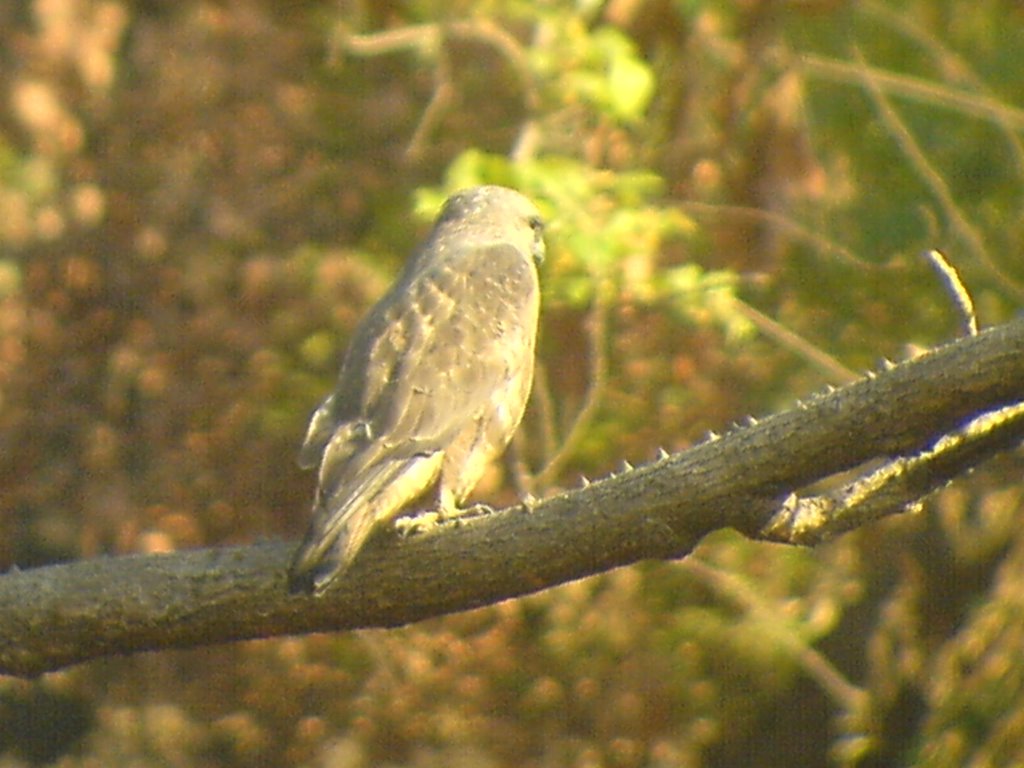
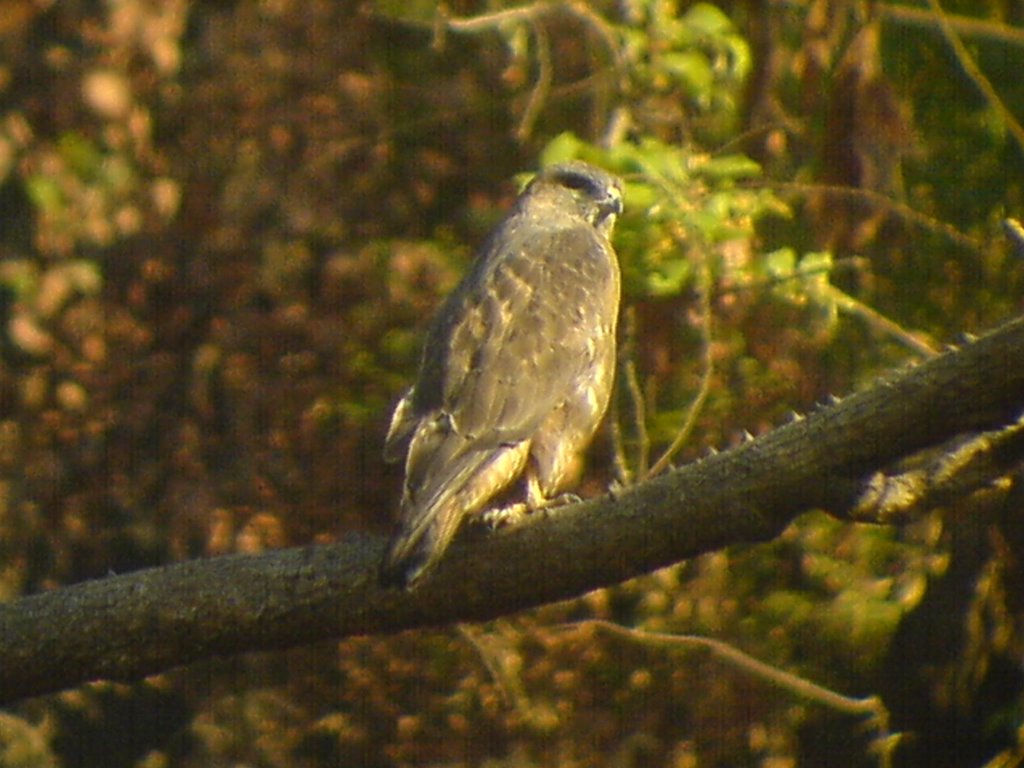
Sunday, January 22, 2006
HSBC Bird Race'06 - Report from team "Flamingos"
Hi All,
January 2006 had been a very exhaustive birding for me. It all started from the 1st day of the year itself..…….I thought that I would be concentrating on my new Job…..the birdies, however kept me busy all thro'out the month and with the 2 nd HSBC Bird race 2006 fast approaching, I knew it would be a birding frenzy all over……
Plenty of last moment changes found myself accommodating in a Thane team, infact my original team had to be moulded almost 11 times in 10 days. Anyways I am glad that I had an opportunity to bird with new people……Our team consisted of Dr. Nyayate as our team captain, Mrs. Subhadha Nyayate, Mrs. Seema Ketkar & myself. Our contact point was the forest check post at the base of Yevoor at 7.00 am (22nd Jan'06). I got up half asleep (what with the hectic week before the bird race, juggling with all permutations and combinations)….but Riding by bike all the way from Sion to Thane in the early chilly hrs made me forget all about my sleep…..…
I was meeting my team colleagues for the first time, but thoroughly enjoyed birding with them all thro' the day…..their enthusiasm and zest percolated in my tired soul which gave me enough energy for the entire day (I was all the time on my bike moving from diff. places)…….
Yevoor: Our first location was Yevoor, Thane. It is a part of the north-eastern side of SGNP and quite rich in Birdlife and we were hopeful of catching up plenty of Forest species here. We not only saw many species (39 nos.) but came out satisfied more than just listing. …….The Bird Race prompted many people (almost all) to reach the locations very early in the morning and am sure most (particularly the newcomers) must have realized the importance and logic to start early…….
In a forest where the foliage limits the visibility, one has to be really attentive to the bird calls….infact it is safe to conclude that in a forest habitat, it is "Birding with Ears" more than the eyes. This helps not only to identify but also to trace that particular bird at exact locations (Habit wise…..as in woodpecker on tree stumps, Minivets on tree tops, Ioras in tree foliage etc.), to be more attentive, learn to concentrate etc ……..our team was well disciplined and deeply attentive and we sure were rewarded with ample no. of calls and sightings.
Our first bird for the day was a Greenish leaf warbler with its unmistakable call, followed immediately with a Crow pheasant…..so it was a good omen …..followed by Chestnut shouldered petronias, E.Golden & B.Hooded Orioles, Purple & P.Rumped sunbirds, W.Browed bulbuls, S.Green beeeaters, and very clear "wut wut wut" calls of the Collard Scop's Owl……….The drongos were everywhere and we were able to spot 5 out of the possible 6 species of drongos (except Bronze), dominated by Ashy, but the highlight was a magnificent Spangled drongo thro' the S.scope……
After my Dandeli visit, the call of Vernal hanging parrot had embedded in my mind permanently and I was surprised to hear this call in Yevoor…..this bird has this characteristic 2 note call that it gives in flight. Since we had not seen it, I thought, It was just my imagination and excitement……but then I heard it 3 more times and on the fifth occasion could sight it as it dashed through the canopy…..The sighting was special because its rarely seen in Mumbai region and a thorough lookout is needed for this otherwise perfectly camouflaging bird…..It was surely my "Bird of the day" …..And, the call helps!!
Our luck continued with calls and we traced the Brown capped pigmy woodpeckers near the broad stream where we had other wonderful delights waiting for us including C.woodshrikes, O.Honey Buzzard, C.Serpent eagle, R.Treepies, Malabar whistling thrush (calls), Redbreasted flycathers (call)…Only "I" had a glimpse of a Black rumped flameback…….but could not list it as per the rule…..
We had sightings of Scarlet Minivets at very close range. Looking at the gorgeous colours of both male and female S.minivets was enjoyed with some "Oohhs" and "Ahhs" and was enough reason for our team captain to declare it as our "Bird of the day"……On the way we meet another team (Hope-Thane)…shared our sightings and moved on…..it was nice to learn about their commendable activities on awareness towards nature….many children's and teachers had joined one of their regular nature trails that day.
Airoli: We were late to reach Airoli, our next location, but fortunately the low tide helped us to see many waders……this spot (thanks to Parag Damle from Mulund & Julius Rego from Airoli) is now frequented & reported regularly. Huge numbers of waders greeted us and we got all the sandpipers (except Broadbilled) here i.e. Terek, Common, Curlew, Spotted/wood, Green and Marsh sandpipers. Also Black tailed godwits, B.W.Stilts, Common Red & Green Shanks. Gulls were a plenty too and with the S.Scope it was easy for us to separate the Slenderbilled gulls from Black & Brown headed gulls (and mobilescope too)…….Further down we also added Common babblers, W.Cheeked bulbuls, E.Marsh harriers, S.Breasted munias, A.Pied starlings and L.tailed shrikes to our now swelling list.
IIT, Powai: Our 3rd Location was IIT Powai. With Dr.Nyayate (he is a professor in Gyansadhna College, Thane), we didn't have problem with permission to enter the campus and near the wonderful Powai lake. I had birded around Powai on many occasions, but never had the opportunity to bird from inside the campus. Thanks to the Bird Race, I got my first chance to appreciate the beautiful IIT campus and the road bordering the lake. Two teams lead by Dr.Ajay Pradhan and Sanal Nair were also present there and we had some wonderful time Birdwatching with these equally wonderful people. Amongst the new species added in our list were Purple herons & Swamphens, Common & W.Throated Kingfishers, Both Phesant tailed & Bronzewinged Jacanas, Glossy Ibis, Common Coots, Spotbills & Lesser whistling ducks, C.Pigmy goose, Indian & Little cormorants, Whiskered terns and a very acrobatic Osprey that delighted everyone with his diving prowess to catch his prey.
Sewri: It was already 3 pm and we still had one more location to cover-Sewri and though the teammates were tired, all had enough strength and zeal to continue……after refreshing ourselves with tea at one of Mr.Nyayate's relatives (One Dr.Wangikar, who won the President's Junior scientist award for 2005- truly inspiring) we proceeded towards Sewri, that we intended to reach before the high tide (at 5.08 pm) and catch up those marvelous birds on which we had named our team (Flamingos) …… Sensing too much crowd near the main jetty and also the fact that the high tide reaches there first we diverted towards the Colgate factory, only to find almost 7 teams there…….It was wonderful to see so many birding colleagues and especially new birders together ( wearing the wonderful HSBC T-Shirts) along with the curious people that thronged the place………
The sheer sight of the flamingos helped us to forget about all the fatigue of the day. Both lesser and Greater flamingos were close to the shore along with some other waders, Gulls & Terns. Grey plovers, Eurasian Curlew, Gullbilled terns, Little ringed plover and a lone Pacific golden plover gave good scope views…whereas the Slender billed gulls were appreciated by all……….The private BPT road (Toll Rs.20/car) that joins Sewri to Chembur RCF colony is another good place to bird and we added Paddyfield pipits and Common Mynas to our final tally of 111 birds.
All throughout the day surprisingly….and quite surprisingly we didn't sight a single wagtail of any species…..in Powai, Airoli or Sewri and hence our "Dip of the Day" was Wagtails……..Many people saw them though…but the overall numbers seem to have declined this year.
The evening function was held at a convenient location- Maharashtra Nature Park and it was heartening to see so many birders (almost 180+) on one platform and coming from all over the region, some as far as Pune, Chakan, Badlapur (and that too present, after a long & exhaustive full day birding) ……The arrangements were well done, thanks to Mr.Avinash Kubal (Dy.Director of MNP) and the short presentation well given, especially the Kids from Udayanchal school, Godrej and the children from Chakan…….I am sure the poem and presentation by them have inspired many, who were present……….moreover their keen observations on bird behavior, taught us some lessons on how to observe birds.
Though there were only 4 prizes, there was never a hint of Losing ….everyone had won, everybody had enjoyed ……it was a day not just for listing down birds that were sighted, as many people have been unfortunately making out……but a step forward, in making "Birdwatching as a Hobby" more popular, To know more about the avain data of the region, To sensitize more people towards birdwatching, that no doubt is a door to enter the wonders of nature, an opportunity for many (especially team captains) to lead a small group, so that they lead larger groups in future, To bring the birders on a single platform and share their knowledge……………and much much more………
A very Big Thanks to HSBC, who have being supporting the event for the last 2 years and for those T-shirts and caps….those were lovely and attracted many people's attention towards our cause.
A huge thanks to Sunjoy Monga who, as always have been taking initiatives to organize such events and encouraging many people….and Mandar Khadilkar for helping out.
It was a great opportunity to interact with so many birders on a single day and appreciate their passion for the hobby from a 7 yr old to 70+ yrs young….its infectious. I hope more people would join in next time, most importantly, to share their knowledge with the novices and to motivate new people….this year there were 175 participants, but I hope to see 175 teams next time.
And Finally, my deep gratitude to the Birds who delight and motivated me as always …………….
Happy Birding,
Addi The Birde
Complete list of the Team "Flamingos"
1) Jungle babbler
2) Brown-headed Barbet (large green)
3) Coppersmith Barbet
4) Small Green bee-eater
5) Red-vented bulbul
6) Red-whiskered bulbul
7) White-browed bulbul
8) White-eared (white-cheeked) bulbul
9) Oriental honey buzzard
10) Common Coot
11) Indian cormorant
12) Little cormorant
13) Coucal, Greater (Crow pheasant)
14) House crow
15) Large-billed (jungle) crow
16) Eurasian Curlew
17) Laughing (little brown) dove
18) Spotted dove
19) Ashy drongo
20) Black drongo
21) Greater racket-tailed drongo
22) Spangled drongo
23) White-bellied drongo
24) Spot-billed duck
25) Booted eagle
26) Crested serpent eagle
27) Cattle egret
28) Great egret
29) Intermediate (median) egret
30) Little egret
31) Greater flamingo
32) Lesser flamingo
33) Pale-billed (tickell's) flowerpecker
34) Thick-billed flowerpecker
35) Asian paradise flycather
36) Monarch, black-naped
37) Red-throated flycather
38) Tickell's blue flycather
39) Gargeny teal
40) Common Greenshank
41) Black-tailed Godwit
42) Cotton pygmy(cotton teal) goose
43) Black-headed gull
44) Brown-headed gull
45) Slender-billed gull
46) Eurasian marsh harrier
47) Grey heron
48) Indian pond heron
49) Purple heron
50) Glossy Ibis
51) Common Iora
52) Bronze-winged Jacana
53) Pheasant-tailed Jacana
54) Common kingfisher
55) White-throated kingfisher
56) Black kite
57) Asian Koel
58) Red-wattled lapwing
59) Rufous-tailed lark
60) Golden-fronted leafbird (Chloropsis)
61) Scarlet minivet
62) Scaly-breasted munia
63) Common Myna
64) Black-hooded Oriole
65) Eurasian golden Oriole
66) Osprey
67) Collared Scops Owl
68) Alexandrine Parakeet
69) Plum-headed Parakeet
70) Rose-ringed Parakeet
71) Vernal Hanging Parrot(Lorikeet)
72) Chestnut headed petronia
73) Blue Rock Pigeon
74) Paddy-field pipit
75) Grey Plover
76) Little ringed Plover
77) Pacific, golden Plover
78) Ashy Prinia
79) Grey-breasted Prinia
80) Plain Prinia
81) Common Redshank
82) Indian Robin
83) Oriental magpie Robin
84) Common sandpiper
85) Curlew sandpiper
86) Green sandpiper
87) Marsh sandpiper
88) Terek sandpiper
89) Wood sandpiper
90) Shikra
91) Long-tailed Shrike
92) House sparrow
93) Asian-pied (pied myna) starling
94) Black winged stilt
95) Purple sunbird
96) Purple-rumped sunbird
97) Barn Swallow
98) Red-rumped Swallow
99) Wire-tailed Swallow
100) Purple Swamphen
101) Asian palm Swift
102) Common Tailorbird
103) Gull-billed Tern
104) Whiskered Tern
105) Malabar whistling Thrush
106) Rufous Tree-Pie
107) Booted warbler
108) Greenish warbler
109) Brown-headed pygmy woodpecker
110) Yellow-crowed (Mahratta) woodpecker
111) Common wood-shrike
January 2006 had been a very exhaustive birding for me. It all started from the 1st day of the year itself..…….I thought that I would be concentrating on my new Job…..the birdies, however kept me busy all thro'out the month and with the 2 nd HSBC Bird race 2006 fast approaching, I knew it would be a birding frenzy all over……
Plenty of last moment changes found myself accommodating in a Thane team, infact my original team had to be moulded almost 11 times in 10 days. Anyways I am glad that I had an opportunity to bird with new people……Our team consisted of Dr. Nyayate as our team captain, Mrs. Subhadha Nyayate, Mrs. Seema Ketkar & myself. Our contact point was the forest check post at the base of Yevoor at 7.00 am (22nd Jan'06). I got up half asleep (what with the hectic week before the bird race, juggling with all permutations and combinations)….but Riding by bike all the way from Sion to Thane in the early chilly hrs made me forget all about my sleep…..…
I was meeting my team colleagues for the first time, but thoroughly enjoyed birding with them all thro' the day…..their enthusiasm and zest percolated in my tired soul which gave me enough energy for the entire day (I was all the time on my bike moving from diff. places)…….
Yevoor: Our first location was Yevoor, Thane. It is a part of the north-eastern side of SGNP and quite rich in Birdlife and we were hopeful of catching up plenty of Forest species here. We not only saw many species (39 nos.) but came out satisfied more than just listing. …….The Bird Race prompted many people (almost all) to reach the locations very early in the morning and am sure most (particularly the newcomers) must have realized the importance and logic to start early…….
In a forest where the foliage limits the visibility, one has to be really attentive to the bird calls….infact it is safe to conclude that in a forest habitat, it is "Birding with Ears" more than the eyes. This helps not only to identify but also to trace that particular bird at exact locations (Habit wise…..as in woodpecker on tree stumps, Minivets on tree tops, Ioras in tree foliage etc.), to be more attentive, learn to concentrate etc ……..our team was well disciplined and deeply attentive and we sure were rewarded with ample no. of calls and sightings.
Our first bird for the day was a Greenish leaf warbler with its unmistakable call, followed immediately with a Crow pheasant…..so it was a good omen …..followed by Chestnut shouldered petronias, E.Golden & B.Hooded Orioles, Purple & P.Rumped sunbirds, W.Browed bulbuls, S.Green beeeaters, and very clear "wut wut wut" calls of the Collard Scop's Owl……….The drongos were everywhere and we were able to spot 5 out of the possible 6 species of drongos (except Bronze), dominated by Ashy, but the highlight was a magnificent Spangled drongo thro' the S.scope……
After my Dandeli visit, the call of Vernal hanging parrot had embedded in my mind permanently and I was surprised to hear this call in Yevoor…..this bird has this characteristic 2 note call that it gives in flight. Since we had not seen it, I thought, It was just my imagination and excitement……but then I heard it 3 more times and on the fifth occasion could sight it as it dashed through the canopy…..The sighting was special because its rarely seen in Mumbai region and a thorough lookout is needed for this otherwise perfectly camouflaging bird…..It was surely my "Bird of the day" …..And, the call helps!!
Our luck continued with calls and we traced the Brown capped pigmy woodpeckers near the broad stream where we had other wonderful delights waiting for us including C.woodshrikes, O.Honey Buzzard, C.Serpent eagle, R.Treepies, Malabar whistling thrush (calls), Redbreasted flycathers (call)…Only "I" had a glimpse of a Black rumped flameback…….but could not list it as per the rule…..
We had sightings of Scarlet Minivets at very close range. Looking at the gorgeous colours of both male and female S.minivets was enjoyed with some "Oohhs" and "Ahhs" and was enough reason for our team captain to declare it as our "Bird of the day"……On the way we meet another team (Hope-Thane)…shared our sightings and moved on…..it was nice to learn about their commendable activities on awareness towards nature….many children's and teachers had joined one of their regular nature trails that day.
Airoli: We were late to reach Airoli, our next location, but fortunately the low tide helped us to see many waders……this spot (thanks to Parag Damle from Mulund & Julius Rego from Airoli) is now frequented & reported regularly. Huge numbers of waders greeted us and we got all the sandpipers (except Broadbilled) here i.e. Terek, Common, Curlew, Spotted/wood, Green and Marsh sandpipers. Also Black tailed godwits, B.W.Stilts, Common Red & Green Shanks. Gulls were a plenty too and with the S.Scope it was easy for us to separate the Slenderbilled gulls from Black & Brown headed gulls (and mobilescope too)…….Further down we also added Common babblers, W.Cheeked bulbuls, E.Marsh harriers, S.Breasted munias, A.Pied starlings and L.tailed shrikes to our now swelling list.
IIT, Powai: Our 3rd Location was IIT Powai. With Dr.Nyayate (he is a professor in Gyansadhna College, Thane), we didn't have problem with permission to enter the campus and near the wonderful Powai lake. I had birded around Powai on many occasions, but never had the opportunity to bird from inside the campus. Thanks to the Bird Race, I got my first chance to appreciate the beautiful IIT campus and the road bordering the lake. Two teams lead by Dr.Ajay Pradhan and Sanal Nair were also present there and we had some wonderful time Birdwatching with these equally wonderful people. Amongst the new species added in our list were Purple herons & Swamphens, Common & W.Throated Kingfishers, Both Phesant tailed & Bronzewinged Jacanas, Glossy Ibis, Common Coots, Spotbills & Lesser whistling ducks, C.Pigmy goose, Indian & Little cormorants, Whiskered terns and a very acrobatic Osprey that delighted everyone with his diving prowess to catch his prey.
Sewri: It was already 3 pm and we still had one more location to cover-Sewri and though the teammates were tired, all had enough strength and zeal to continue……after refreshing ourselves with tea at one of Mr.Nyayate's relatives (One Dr.Wangikar, who won the President's Junior scientist award for 2005- truly inspiring) we proceeded towards Sewri, that we intended to reach before the high tide (at 5.08 pm) and catch up those marvelous birds on which we had named our team (Flamingos) …… Sensing too much crowd near the main jetty and also the fact that the high tide reaches there first we diverted towards the Colgate factory, only to find almost 7 teams there…….It was wonderful to see so many birding colleagues and especially new birders together ( wearing the wonderful HSBC T-Shirts) along with the curious people that thronged the place………
The sheer sight of the flamingos helped us to forget about all the fatigue of the day. Both lesser and Greater flamingos were close to the shore along with some other waders, Gulls & Terns. Grey plovers, Eurasian Curlew, Gullbilled terns, Little ringed plover and a lone Pacific golden plover gave good scope views…whereas the Slender billed gulls were appreciated by all……….The private BPT road (Toll Rs.20/car) that joins Sewri to Chembur RCF colony is another good place to bird and we added Paddyfield pipits and Common Mynas to our final tally of 111 birds.
All throughout the day surprisingly….and quite surprisingly we didn't sight a single wagtail of any species…..in Powai, Airoli or Sewri and hence our "Dip of the Day" was Wagtails……..Many people saw them though…but the overall numbers seem to have declined this year.
The evening function was held at a convenient location- Maharashtra Nature Park and it was heartening to see so many birders (almost 180+) on one platform and coming from all over the region, some as far as Pune, Chakan, Badlapur (and that too present, after a long & exhaustive full day birding) ……The arrangements were well done, thanks to Mr.Avinash Kubal (Dy.Director of MNP) and the short presentation well given, especially the Kids from Udayanchal school, Godrej and the children from Chakan…….I am sure the poem and presentation by them have inspired many, who were present……….moreover their keen observations on bird behavior, taught us some lessons on how to observe birds.
Though there were only 4 prizes, there was never a hint of Losing ….everyone had won, everybody had enjoyed ……it was a day not just for listing down birds that were sighted, as many people have been unfortunately making out……but a step forward, in making "Birdwatching as a Hobby" more popular, To know more about the avain data of the region, To sensitize more people towards birdwatching, that no doubt is a door to enter the wonders of nature, an opportunity for many (especially team captains) to lead a small group, so that they lead larger groups in future, To bring the birders on a single platform and share their knowledge……………and much much more………
A very Big Thanks to HSBC, who have being supporting the event for the last 2 years and for those T-shirts and caps….those were lovely and attracted many people's attention towards our cause.
A huge thanks to Sunjoy Monga who, as always have been taking initiatives to organize such events and encouraging many people….and Mandar Khadilkar for helping out.
It was a great opportunity to interact with so many birders on a single day and appreciate their passion for the hobby from a 7 yr old to 70+ yrs young….its infectious. I hope more people would join in next time, most importantly, to share their knowledge with the novices and to motivate new people….this year there were 175 participants, but I hope to see 175 teams next time.
And Finally, my deep gratitude to the Birds who delight and motivated me as always …………….
Happy Birding,
Addi The Birde
Complete list of the Team "Flamingos"
1) Jungle babbler
2) Brown-headed Barbet (large green)
3) Coppersmith Barbet
4) Small Green bee-eater
5) Red-vented bulbul
6) Red-whiskered bulbul
7) White-browed bulbul
8) White-eared (white-cheeked) bulbul
9) Oriental honey buzzard
10) Common Coot
11) Indian cormorant
12) Little cormorant
13) Coucal, Greater (Crow pheasant)
14) House crow
15) Large-billed (jungle) crow
16) Eurasian Curlew
17) Laughing (little brown) dove
18) Spotted dove
19) Ashy drongo
20) Black drongo
21) Greater racket-tailed drongo
22) Spangled drongo
23) White-bellied drongo
24) Spot-billed duck
25) Booted eagle
26) Crested serpent eagle
27) Cattle egret
28) Great egret
29) Intermediate (median) egret
30) Little egret
31) Greater flamingo
32) Lesser flamingo
33) Pale-billed (tickell's) flowerpecker
34) Thick-billed flowerpecker
35) Asian paradise flycather
36) Monarch, black-naped
37) Red-throated flycather
38) Tickell's blue flycather
39) Gargeny teal
40) Common Greenshank
41) Black-tailed Godwit
42) Cotton pygmy(cotton teal) goose
43) Black-headed gull
44) Brown-headed gull
45) Slender-billed gull
46) Eurasian marsh harrier
47) Grey heron
48) Indian pond heron
49) Purple heron
50) Glossy Ibis
51) Common Iora
52) Bronze-winged Jacana
53) Pheasant-tailed Jacana
54) Common kingfisher
55) White-throated kingfisher
56) Black kite
57) Asian Koel
58) Red-wattled lapwing
59) Rufous-tailed lark
60) Golden-fronted leafbird (Chloropsis)
61) Scarlet minivet
62) Scaly-breasted munia
63) Common Myna
64) Black-hooded Oriole
65) Eurasian golden Oriole
66) Osprey
67) Collared Scops Owl
68) Alexandrine Parakeet
69) Plum-headed Parakeet
70) Rose-ringed Parakeet
71) Vernal Hanging Parrot(Lorikeet)
72) Chestnut headed petronia
73) Blue Rock Pigeon
74) Paddy-field pipit
75) Grey Plover
76) Little ringed Plover
77) Pacific, golden Plover
78) Ashy Prinia
79) Grey-breasted Prinia
80) Plain Prinia
81) Common Redshank
82) Indian Robin
83) Oriental magpie Robin
84) Common sandpiper
85) Curlew sandpiper
86) Green sandpiper
87) Marsh sandpiper
88) Terek sandpiper
89) Wood sandpiper
90) Shikra
91) Long-tailed Shrike
92) House sparrow
93) Asian-pied (pied myna) starling
94) Black winged stilt
95) Purple sunbird
96) Purple-rumped sunbird
97) Barn Swallow
98) Red-rumped Swallow
99) Wire-tailed Swallow
100) Purple Swamphen
101) Asian palm Swift
102) Common Tailorbird
103) Gull-billed Tern
104) Whiskered Tern
105) Malabar whistling Thrush
106) Rufous Tree-Pie
107) Booted warbler
108) Greenish warbler
109) Brown-headed pygmy woodpecker
110) Yellow-crowed (Mahratta) woodpecker
111) Common wood-shrike
Monday, December 19, 2005
Bhigwan - A “Big One” for Ducks and Waterfowl
 Hi All,
The wetlands in North (India) generally are very good spots to see huge nos. of migratory waterfowls especially ducks as compared to South (India) …….. But if you visit “Bhigwan” near Pune it is a different story……It’s definitely a “Big One” for Ducks.
Bhigwan is about 95 Kms from Pune on the Pune-Solapur highway (NH-9) and is a catchment area of the mighty Ujani Dam. It is a proposed sanctuary for migratory birds, an area of about 18000 hectares. The water catchment area is spread across around the town of Bhigwan……..This is probably the best spot in South Central India to see ducks in enormous numbers….the whole area is mesmerizing & reminiscence to the wetlands of the north.
For a long time I wished to visit this place (I had a glimpse of this spot way back in 2002 for about 2 Hrs on the way to Nannaj, Solapur) and so we (Myself, Mandar Khadilkar, Abhijeet Narvekar & Palavi Joshi) decided to birdwatch around Bhigwan on 19th Dec’05……Thanks to Abhijeet for his Zen and a long drive, we started from Mumbai on 18th Dec’05 in the evening and reached non-stop to Bhigwan town by 11.30 p.m…….There are not many hotels to stay here and it is advisable to halt for the night in Pune….we got a hotel though (If I could call it as a hotel, the electric switches of which reminded us of “Suduko” game) with unlocked bathrooms & Open windows…we somehow survived the night…..
We started early next day (19th Dec’05) for birding. Mandar had done some research (opps?) on the routes and good spots and also with some help from Mr.Gaurav Purohit (Pune) managed to cover 4 major spots around Bhigwan in a single day – Kumbhargaon, Diksal, Patas & Varwand dam ……..
Kumbhargaon: To reach this spot one has to take the highway from Bhigwan town towards Solapur, cross a bridge (about 2 kms.) and take a left “Kuccha” Road (there is a board named Kumbhargaon)….about a km from the main road, the vast expanse of the Ujani dam area spreads out in front of you…….
The morning was misty and chilly….the first thing that struck us here were huge nos. of Common Coots along the stretch of the water body……Also, we could see thousands of ducks from here that included predominantly the Beautiful Eurasian Wigeons, Gadwalls & Shovellers (Most in their eclipse plumage) other duck species were few viz. Spotbilled, Common Teals, Ruddy sheld ducks, Gargeny. Surprisingly Pochards were nowhere to be seen only one male Common Pochard and a lone female Red crested Pochard was seen mingling in the company of other birds.
There were several other interesting sightings that included, literally thousands of barn swallows, House swifts, Red Rumped swallows, Wire tailed swallows hawking for the insects above, zigzagging just above the ground, oblivious of our presence (We wondered how they do not collide with each other in such rapid flight)…4 Palla’s Gulls, All species of wagtails except White wagtails, Brown & Long tailed shrikes, River, Whiskered and Gull-Billed Terns, Great, Little & Indian Cormorants, Glossy Ibis in huge nos, Asian Openbill and Painted storks……Waders included Wood & Common Sandpipers, Black tailed Godwits, Red Shanks & Black winged stilts…….A soaring pair of Small Falcons could not be identified as they were against the sunlight (I suspect them to be Red Necked falcons from the Gizz)………………I am sure there must be those Pratincoles mixed among the swarms of Swallows, though we couldn’t see any.
There is a Pump house about 500 mts from “Kumbhargaon” village. We hired a boat from here to go close to the ducks. The Boatman was happy to take us at Rs.100 (1/2 of his daily earnings) for a ride……though we were able to go a bit closer to the ducks, they always maintained a certain distance, but it is always a treat to watch these beauties at eye level swimming/feeding/relaxing/preening/floating. The area around the water body is also very good for birding and we added plenty of other birds in our list including, Pied & Common (now Siberian) Stonechats, Golden Orioles, Lesser white throats, Paddy field pipits, Rosy & Brahminy Starlings, Small Green Bee-eaters, Grey Francolins calling and the master of camouflage Yellow wattled Lapwings………
The surrounding place is rich for cultivation of Maze, Sugarcane, Jowar……Burlp….the Corn maze and Sugarcanes were very sweet…
The roads (after the mighty monsoons) were very bumpy and the Maruti Zen's low road clearance bottom kept banging all the time...so much that we eventually had to cristened it as "Maruti Hummer-H2" (The legendry american army vehicle)....however, a Vehicle is a must if one has to cover more spots.
Diksal : To reach this place……take a left turn from Bhigwan (Towards Solapur end) and go straight for about 8-9 kms…..there are a bit twisty turns, but on the way there are many spots to stop and bird. We did the same and were rewarded with a Twany Eagle, Cotton Pigmy Goose, Lesser Whistling Teal, Ruff, Clamorous warblers, Marsh harriers, Comb ducks, More Ruddy shelducks, Common Kestrels……once again Eurasian Wigeons, Gadwalls & Shovellers dominated the scene ……incidentally this is the spot (I learn) where the Greater Flamingos are seen in late winter.
Patas: This place is on the Pune-Solapur highway about 20 kms from Bhigwan…….apparently a good habitat for waterfowls but we saw only few Common Coots, many Purle Herons, Purple swamphens, Common & W.T.Kingfishers, Pheasant tailed Jacanas……..There is a huge heronry along the Eucalyptus trees and a big colony of fruit bats (Flying fox).
Varwand Dam : There are 2 ways to go here …..Either take a right turn just before Bhigwan (About 6 kms) or take a right turn (Kuccha Road) after Bhigwan (Solapur end or the road opp. the road that leads to Diksal) …….We took the later after bothering Mr.Gaurav Purohit for directions…..
After a sumptuous vegetarian Rice plate at a hotel at Bhigwan, we proceeded towards Varwand Dam, While getting directions, we were told by one farmer to stick along the water-pipe going parallel to this road…..we did follow his instructions, but at one point we took a wrong turn and landed up at a dead end….but this was fruitful as, when we stepped out to inspect the barren area ahead, we saw some Indian Coursers running in their peculiar gait, far on the fallow land….on close observation that region revealed more birds that included, Greater short toed larks, tawny pipits and a male Pallied Harrier….apparently a very good habitat for grassland and dry country birds including Sandgrouse (and GIBs) ….Ahh !! this was sure a bonus for us….. nearby, a water canal revealed Little Ringed Plover, R.W.Lapwings, Wood Sandpiper & Longtailed shrikes………
By the time we reached “Varwand” Dam at around 5.00pm, the light had already started to fade but a scan thro’ the Spotting Scope revealed one of the biggest congregation of Ducks …..even at a conservative estimate the Nos. would be anywhere close to 15000…….Lo….how we came late here and missed the light….everyone of us were depressed, as we were unable to identify the ducks (on the other shore) in the fast fading light and to reach the other side where all of them were concentrated, we would have to negotiate a very bad road about a Km. or so that would have taken more time and light…….A huge eagle about a size of Imperial eagle was seen mobbed by a Jungle Crow on the other far side sitting on a pole and we could just judge its size from its silhouette…. Sigh!! We decided to check this place first, in case we happen to visit again………However, the mood was somewhat regained with some clear and close sightings of Barred Button quails on the road……..
I know, there are many Duck crazy birders (err…I mean to see and observe) and Bighwan is a place for them…….Its a “Big One for” Ducks…..
Happy Birding,
Addi The Birde
PS: Thanks for the wonderful company …..It was an enjoyable experience.....Particularly Abhijeet for his vehicle and his uncomplained driving (It was very very tiring) , Palavi for keeping us smiling all the time and Mandar for his directions (Hmmm....) and passion.
Here’s a complete list of the birds seen & heard (Total 104 species):
Barred Button Quail (Clear & Close sightings on the road)
Ruddy Shelduck (few but in all 4 sightings)
Comb Duck (a Pair near Diksal)
Gadwall (Plenty)
Eurasian Wigeon (The most numerous)
Spot Billed Duck (Scattered along the edges)
Gargeney (Very few)
Northen Pintail (about c50)
Northen Shoveller (Plenty…most in eclipse plumage)
Red Crested Pochard (One female)
Lesser Whistling Duck (Only one)
Cotton Pigmy Goose (Near Diksal)
Common Hoopoe (at least 4)
Common Kingfisher
White Breasted Kingfisher
Pied Kingfisher (Only 2 at Varwand)
Green Bee-eater
Asian Koel
Greater Coucal
House Swift
Rock Pigeon
Laughing Dove
Spotted Dove
White Breasted Waterhen (seen one near Patas)
Purple Swamphen (Everywhere)
Common Moorhen
Common Coot (Most numerous)
Wood Sandpiper (Along the edges)
Common Sandpiper
Black Tailed Godwit (One each near Kumbhargaon & Diksal)
Indian Courser (4 at fallow land near Varwand)
Common Red Shank
Ruff ( a Pair near Diksal)
Pheasant Tailed Jacana
Little Ring Plover
Yellow Wattled Lapwing (Many in suitable habitat)
Red Wattled Lapwing
Palla's Gull (About c4 at Kumbhargaon)
Brown Headed Gull
Black Headed Gull
River Tern
Whiskered Tern
Gull-Billed tern
Black Shouldered Kite
Black Kite
Brahminy Kite (one at Patas)
Eurasian Marsh Harrier
Pallied Harrier (one magnificent male)
Shikra
Tawny Eagle (one near Diksal)
Common Kestrel
Little Grebe
Little Cormorant
Indian Cormorant
Great Cormorant (Few)
Little Egret
Great Egret
Intermediate Egret
Cattle Egret
Indian Pond Heron
Grey Heron (Plenty everywhere)
Purple Heron (Many at Patas – a very good habitat for this bird))
Glossy Ibis (Huge flocks)
Oriental White Ibis (2 at Diksal)
Painted Stork (At Diksal & Kumbhargaon)
Asian Openbill (The most common Stork)
Brown Shrike
Long Tailed Shrike
Bay Backed Shrike (One on the way near highway)
House Crow
Large Billed Crow
Small Minivet - call
White Browed Fantail
Black Drongo
Ashy Drongo
Common Stonechat (Now called as Siberian Stonechat)
Pied Bushchat
Brahminy Starling
Rosy Starling
Common Myna
Great Tit (One on the way to Varwand)
Barn Swallow (In thousands)
Wire Tailed Swallow
Red Rumped Swallow
Red Vented Bulbul
Blyth's Reed Warbler
Clamorous Reed Warbler
Lesser Whitethroat (At the Pump house-Kumbhargaon)
Common Tailorbird
Common Chiffchaff
Jungle Babbler
Large Grey Babbler
Ashy Crowned Sparrow Lark
Rufous Tailed Lark
Greater Short Toed Lark (At fallow land near Varwand)
House Sparrow
White Browed Wagtail
Citrine Wagtail (Plenty)
Yellow Wagtail
Grey Wagtail
Paddy field Pipit
Tawny Pipit ((At fallow land near Varwand)
Baya Weaver
Indian Silverbill
Thursday, December 01, 2005
Sewri- The Flamingo days are back (27th Nov'05)
Hi Folks,
After the SGNP in the morning, I, along with Sahshank and a colleague, went to Sewri for a brief visit to check out the arrival of Flamingos on 27th Nov’05 Evening…..
It was a low tide and the birds were very far and with an old ship docked nearby for repairs and banging away, the birds were a bit farther away from the shore….we had a spotting scope though and could see the Lesser flamingos (About 400-500) at far end near the BPCL refinery towers…….However no Greater flamingos……the number is expected to increase in few days.
We had planned to stay only for few mins. But the many curious families that came to see flamingos were looking disappointed at not seeing them (with the naked eyes), so had to volunteer to show them thro’ the scope and explain some facts….surprisingly all of them seemed to know about the proposed sealink.
The sight of the flamingos (thro’ the scope) put a smile on their face, One person even offered us “Watermelon” from a fruitwalla, who sure knew where to park his moving store.
Other birds sighted were, Terek, Curlew, Broadbilled & Common Sandpipers, Pacific Golden & Grey Plovers, Lesser & Greater sand plovers, Little stints, Black tailed Godwits, Curlews, Wimbrels, Common Red & Green Shanks, O.White Ibis, Gull-billed terns, Little, Intermediate, Reef & Great egrets…..and many gulls & terns that were far enough for any id.
Sashank pointed out some black waders…..I instantly thought of spotted Red shanks in breeding plumage…but wait….on closer look, they revealed as oil bathed Curlew / braodbilled sandpipers (Several)…..a day later, Sanshank visited Sewri again and informed of an oil layer on the water near the Excise/customs office end…..on the last visit to Sewri with Mr.Ananth, we saw few Black tailed Godwits with black mask and I had jokingly said that these were the Masked Godwits…now I realized that it was afterall the oil that was responsible for the mask.
Once again for those who wish to go to sewri:
The best time to see Flamingos is 3 hrs before or 2 hrs after the high tide (when the birds are nearer to the shore). The tide timings can be found out from the following site:
http://www.mobilegeographics.com:81/locations/658.html
The Flamingo days are back……….
Cheers!!
Addi The Birde
After the SGNP in the morning, I, along with Sahshank and a colleague, went to Sewri for a brief visit to check out the arrival of Flamingos on 27th Nov’05 Evening…..
It was a low tide and the birds were very far and with an old ship docked nearby for repairs and banging away, the birds were a bit farther away from the shore….we had a spotting scope though and could see the Lesser flamingos (About 400-500) at far end near the BPCL refinery towers…….However no Greater flamingos……the number is expected to increase in few days.
We had planned to stay only for few mins. But the many curious families that came to see flamingos were looking disappointed at not seeing them (with the naked eyes), so had to volunteer to show them thro’ the scope and explain some facts….surprisingly all of them seemed to know about the proposed sealink.
The sight of the flamingos (thro’ the scope) put a smile on their face, One person even offered us “Watermelon” from a fruitwalla, who sure knew where to park his moving store.
Other birds sighted were, Terek, Curlew, Broadbilled & Common Sandpipers, Pacific Golden & Grey Plovers, Lesser & Greater sand plovers, Little stints, Black tailed Godwits, Curlews, Wimbrels, Common Red & Green Shanks, O.White Ibis, Gull-billed terns, Little, Intermediate, Reef & Great egrets…..and many gulls & terns that were far enough for any id.
Sashank pointed out some black waders…..I instantly thought of spotted Red shanks in breeding plumage…but wait….on closer look, they revealed as oil bathed Curlew / braodbilled sandpipers (Several)…..a day later, Sanshank visited Sewri again and informed of an oil layer on the water near the Excise/customs office end…..on the last visit to Sewri with Mr.Ananth, we saw few Black tailed Godwits with black mask and I had jokingly said that these were the Masked Godwits…now I realized that it was afterall the oil that was responsible for the mask.
Once again for those who wish to go to sewri:
The best time to see Flamingos is 3 hrs before or 2 hrs after the high tide (when the birds are nearer to the shore). The tide timings can be found out from the following site:
http://www.mobilegeographics.com:81/locations/658.html
The Flamingo days are back……….
Cheers!!
Addi The Birde
Sunday, November 27, 2005
SGNP - A flock of migratory Amur Falcons
Hi All,
Had a great day birding with Bnhs members on Sunday 27th Nov'05 near Kahneri caves (SGNP-Borivali national park, Mumbai). This was an official Bnhs trail lead by Sanal Nair and self to the highest point, But due to some reasons, got permission only uptill the "Gomukh" point above the Kahneri plateau.
Highlights : A migrating flock of 8 Amur Falcons, Greater spotted Eagle and Verditer flycatcher.
The climate was cool, but the forest was comparatively silent and what with about 35+ people with us.......the sightings and sounds were relatively poor. We started our trail from the base of Kahneri (Opp. to the Tulsi Road) and ended up on the Kahneri plateau.
Most of the birds were identified by calls, that included Greater Racket tailed Drongos, Tickell's, Monarch & Red breasted flycatchers, Tickell's leaf warblers, a sulphur bellied warbler, White Breasted Kingfisher...and had some very good sightings of Verditer Flycatcher, an adult Greater Spotted Eagle (Mobbed by jungle crows), Plum Headed parakeet (Female thro' S.Scope), A Honey Buzzard, Pond Heron, Yellow footed green pigeons, Ashy drongos, Greater coucal, Golden Oriole…….
Reaching at the plateau, I was scanning the area, when I saw a flock of birds approaching from east to west….it was very far and flying rapidly….first I thought they were green pigeons…but so high ?...then I thought their flight resembled sandgrouse…but sandgrouse are not found here……then as they came near, above my head, I realized what I was looking at were Amur falcons….the wing shape, the fast fight and the timing all pointed out towards Amurs…..…..We counted 8 of them and were sure, some more would be on their way…..I tried to scan a little more and waited for a while, but that was the only flock we saw.
Interestingly the Amur falcons are rare passage migrants to Mumbai region and they migrate from Northern China / Mongolia to South Africa…an incredible journey of several thousand Kms.
I was surprised to find no Crag martins……..
Cheers!!
Adesh
Had a great day birding with Bnhs members on Sunday 27th Nov'05 near Kahneri caves (SGNP-Borivali national park, Mumbai). This was an official Bnhs trail lead by Sanal Nair and self to the highest point, But due to some reasons, got permission only uptill the "Gomukh" point above the Kahneri plateau.
Highlights : A migrating flock of 8 Amur Falcons, Greater spotted Eagle and Verditer flycatcher.
The climate was cool, but the forest was comparatively silent and what with about 35+ people with us.......the sightings and sounds were relatively poor. We started our trail from the base of Kahneri (Opp. to the Tulsi Road) and ended up on the Kahneri plateau.
Most of the birds were identified by calls, that included Greater Racket tailed Drongos, Tickell's, Monarch & Red breasted flycatchers, Tickell's leaf warblers, a sulphur bellied warbler, White Breasted Kingfisher...and had some very good sightings of Verditer Flycatcher, an adult Greater Spotted Eagle (Mobbed by jungle crows), Plum Headed parakeet (Female thro' S.Scope), A Honey Buzzard, Pond Heron, Yellow footed green pigeons, Ashy drongos, Greater coucal, Golden Oriole…….
Reaching at the plateau, I was scanning the area, when I saw a flock of birds approaching from east to west….it was very far and flying rapidly….first I thought they were green pigeons…but so high ?...then I thought their flight resembled sandgrouse…but sandgrouse are not found here……then as they came near, above my head, I realized what I was looking at were Amur falcons….the wing shape, the fast fight and the timing all pointed out towards Amurs…..…..We counted 8 of them and were sure, some more would be on their way…..I tried to scan a little more and waited for a while, but that was the only flock we saw.
Interestingly the Amur falcons are rare passage migrants to Mumbai region and they migrate from Northern China / Mongolia to South Africa…an incredible journey of several thousand Kms.
I was surprised to find no Crag martins……..
Cheers!!
Adesh
Sunday, November 20, 2005
Tungareshwar - An overlooked forest
Hi All,
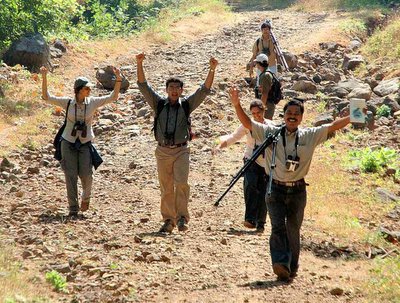
(Photos courtesy: Mr.Murlidhar)
After a splendid last weekend in Tungareshwar, where we saw an Immature Rufous Bellied Hawk Eagle, Malabar parakeets, Crested Tree swifts & White eyes….I wanted to explore this place again and see if I could get a photograph (Mobilescope atleast) of the R.B.H.Eagle..... a very sighnificant sighting for the region.
The recently declared Tungareshwar sanctuary ( deciduos / Moist decidious/ semi evergreen) can be accessed by various routes and having birded there several times by the main route (Vasai/Tungareshwar phata), Mandar suggested to take another route that is close to the famous Vajreshwari springs…….To reach this place one has to go via the Ahmedabad Highway, take a right turn at Shirsat Phata (Or Vajreshwari Phata) and after crossing “Usgaon” (8-10 kms from Shirsat) village about a km., there is a Kuccha road that leads to the “Sadanand Baba Ashram” ….there is a board that announces this…… 
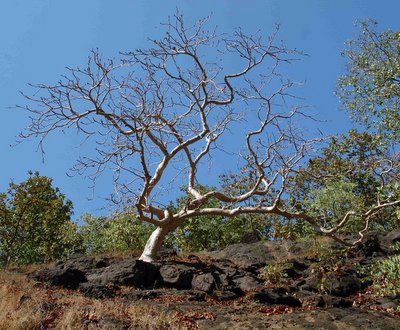
 Last Sunday (…), we had some good catch like Malabar parakeets, White-eyes, Crested tree swifts, Y.Legged Green Pigeons etc…….. We were lucky with Malabar parakeets (Western ghats endemic) this time as well…..This area apparently seems to be the northern most range of its distribution ( Sunjoy informs , he too has sightings of these parakeets from this area) …….We also had a very clear and confirmed sighting of Juv. R.B.H.Eagle. This species has distribution from Goa south and we all were surprised and stunned to find this bird here…way way north…..The unmistakable black hood and whiter under parts and the small size ( +Booted eagle ) makes its ID fairly easy.
It was not a particularly happy day for me though……firstly my mobile phone (Mobilescope fame) went dead and I have to give it for repairs, secondly my S.Scope fell and broke the adapter (Thankfully the optics are safe), so could not use it for the trip (And won’t use atleast for a couple of weeks now) and lastly my right eye got some particle and was sore………
The prospect of sighting a Rufous bellied Eagle, had Venkat come all the way from Chembur and Amod Karkhanis & Mr.Anil Kunte from Thane at 7.00 am on 20th Nov'05, rest of us had stayed at Mandar's ( Dahisar)........ 

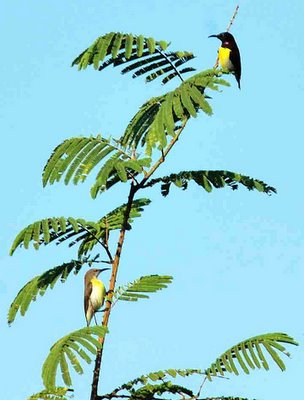 The climate, however was cool when we* spotted our first species- a pair of Common Rosefinches. Continued with Malabar parakeets, White browed Bulbuls, Imm. Shikra, O.Honey buzzard, E.Golden & Black hooded Orioles, Small minivets, Rufous bellied babblers etc…..
 Pugmarks of a Leopard in the mud on the main path and further on, of a Civet cat (Mr.Anil Kunte) indicated of a good healthy forest, but the rampant woodcutting activity along the way made us realise the true picture……..
Among the other species we saw were Verditer flycatcher, White bellied, Ashy and Greater Racket tailed drongos, Common woodshrikes, Redbreasted, Paradise & Monarch flycathers, Greenish leaf warblers singing, a Good sighting of Western crowned leaf warbler and Sulphur bellied warblers, Thick billed and Pale billed flowerpeckers, Common Ioras, Black headed cuckoo shrike, Yellow crowned woodpecker, Plenty of Crested tree swifts, Tree pipit, Grey brested prinias in non-breeding flocks. Also what I thought was a Tytlers leaf warbler, but could not confirm…… Good & plenty sightings of Eurasian Crag martins hawking insects along with the swallows and swifts……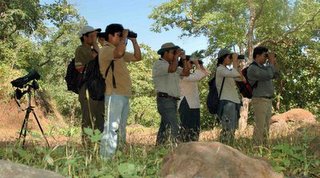
The region seems very good for forest raptors. We had very good and prolonged sightings of a pair of Changeable hawk eagles and with the breeding season commencing, this pair is expected to stick to this place, also magnificent Black Eagle rising on the thermals….one has to see it, to experience the graceful flight of these majestic eagles with the glistening black feathers shining in the sun rays………
Though I birded with my damaged phone (camera), Spotting Scope and one eye, I had my 2 ears, 1 eye, and wonderful birding pals with me …….
This part of Tungareshwar deserves more visits that promises plenty of surprises…..
Happy Birding,
Adesh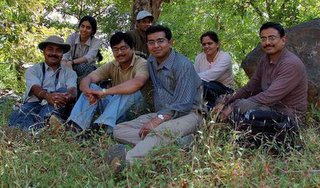
*Participants (on 14th Nov'05) : Myself, Ashwini Vaidya, Mandar Khadilkar, Abhijeet Narvekar, Animish Mandhrekar, Ms.Pallavi Joshi & Mr.Murlidhar
On 20th Nov: Venkat Krishnan, Amod Karkhanis & Mr.Anil Kunte.
Sunday, July 10, 2005
Karnala & Indian Pitta - The SUSPECT (10.7.05)
Hi All,
It’s nice to see after a long time,so many people, contributing their sightings on the group…let me as well give my share.
After a very long Hibernation (almost 2 months), I had been to Karnala on 10th July’05 with Bob (Iwan) Roberts, Vidya Rao & Shashank Dalvi.
It was pretty late (9.00 am) when we reached there. The weather was very humid and hot. With no rains for almost a week, we were certain to miss out on the numerous mushroom species that emerge out and for which Karnala is a superb place.
We were greeted with plenty of bird calls, with Vidya looking absolutely lost. There were calls of Sunbirds, flowerpeckers, Ioras, drongos, minivets…..One bird call, however caught our attention. It was that distinct call Weet….weview……an Indian Pitta. Now, this bird (Also called as “Navrang”) is thought to be a passage migrant for our region, moving from South to North & central India for breeding and can be encountered during end May & initial June and again in October on their return journey….. Well this was July, its peak breeding season. Also some of my friends who went to Phansad the following Tuesday also informed me that they saw & heard quite a few Pittas ( and then Dr.Vaibhav also confirmed seeing Pittas near Alibaug regularly in July)….This particular bird responded to the calls we made and was looking in a very challenging mood, and was calling continuously, thinking of some intrusion on its territory. I SUSPECT this species may be nesting here in small nos……… However while scanning thro’ records I found this comment from Dr.Salim Ali-- “Breeds sporadically e.g. Bombay environs. Mainly southwest monsoon winter visitor and/or passage migrant in peninsula India,” Ali, S. & Ripley, S. D. 1983;. (From compilation by Anand Prasad, BOB files)
Click the following to view this beautiful bird: http://www.orientalbirdimages.org/birdimages.php?action=birdspecies&Bird_ID=1313&Bird_Image_ID=12558&Bird_Family_ID=142&p=8
While photographing this bird with my handy cam, I had a bad fall twisting my left wrist, while shooing away a Rhesus Macacque, which was attracted to my un-attended bag on the ground……
Further down the “Mortaka trail” we encountered a very good mixed hunting party of birds that almost had 13 species…..including G.R.tailed drongo, Whitebellied and Bronze drongos, Palebilled & thickbilled flowerpeckers, Purple & Crimson backed Sunbirds, Black hooded Orioles, A party of C.Wood shrikes, Spotted Babblers, Ioras…..etc. a party of c3 C.Serpant Eagles was soaring above (Probably a family), calls of Malabar whistling thrush, Quaker babbler, L.Flameback, Monarch flycatcher, Grey jungle fowl etc….. Surprisingly no cuckoo calls or Orange headed thrush calls were heard.
Mr.Chandrashekhar Marathe (RFO-Karnala) showed us the stuffed Leopard and a tiger that was gifted by the Late actor Mr.Ashok Kumar Ganguly, which are kept in their guest house (Mayur)… he was also kind enough to share, what the forest department is trying to do to maintain the forest & the various activities including nature education….but also expressed the Dept’s helplessness due to lack of guards & beaurocracy……..
With the rains now in full flow, Karnala should be very good for birds, plants, insects & amphibians.
Happy Birding,
Addi the Birde
Mumbai
9820455713
It’s nice to see after a long time,so many people, contributing their sightings on the group…let me as well give my share.
After a very long Hibernation (almost 2 months), I had been to Karnala on 10th July’05 with Bob (Iwan) Roberts, Vidya Rao & Shashank Dalvi.
It was pretty late (9.00 am) when we reached there. The weather was very humid and hot. With no rains for almost a week, we were certain to miss out on the numerous mushroom species that emerge out and for which Karnala is a superb place.
We were greeted with plenty of bird calls, with Vidya looking absolutely lost. There were calls of Sunbirds, flowerpeckers, Ioras, drongos, minivets…..One bird call, however caught our attention. It was that distinct call Weet….weview……an Indian Pitta. Now, this bird (Also called as “Navrang”) is thought to be a passage migrant for our region, moving from South to North & central India for breeding and can be encountered during end May & initial June and again in October on their return journey….. Well this was July, its peak breeding season. Also some of my friends who went to Phansad the following Tuesday also informed me that they saw & heard quite a few Pittas ( and then Dr.Vaibhav also confirmed seeing Pittas near Alibaug regularly in July)….This particular bird responded to the calls we made and was looking in a very challenging mood, and was calling continuously, thinking of some intrusion on its territory. I SUSPECT this species may be nesting here in small nos……… However while scanning thro’ records I found this comment from Dr.Salim Ali-- “Breeds sporadically e.g. Bombay environs. Mainly southwest monsoon winter visitor and/or passage migrant in peninsula India,” Ali, S. & Ripley, S. D. 1983;. (From compilation by Anand Prasad, BOB files)
Click the following to view this beautiful bird: http://www.orientalbirdimages.org/birdimages.php?action=birdspecies&Bird_ID=1313&Bird_Image_ID=12558&Bird_Family_ID=142&p=8
While photographing this bird with my handy cam, I had a bad fall twisting my left wrist, while shooing away a Rhesus Macacque, which was attracted to my un-attended bag on the ground……
Further down the “Mortaka trail” we encountered a very good mixed hunting party of birds that almost had 13 species…..including G.R.tailed drongo, Whitebellied and Bronze drongos, Palebilled & thickbilled flowerpeckers, Purple & Crimson backed Sunbirds, Black hooded Orioles, A party of C.Wood shrikes, Spotted Babblers, Ioras…..etc. a party of c3 C.Serpant Eagles was soaring above (Probably a family), calls of Malabar whistling thrush, Quaker babbler, L.Flameback, Monarch flycatcher, Grey jungle fowl etc….. Surprisingly no cuckoo calls or Orange headed thrush calls were heard.
Mr.Chandrashekhar Marathe (RFO-Karnala) showed us the stuffed Leopard and a tiger that was gifted by the Late actor Mr.Ashok Kumar Ganguly, which are kept in their guest house (Mayur)… he was also kind enough to share, what the forest department is trying to do to maintain the forest & the various activities including nature education….but also expressed the Dept’s helplessness due to lack of guards & beaurocracy……..
With the rains now in full flow, Karnala should be very good for birds, plants, insects & amphibians.
Happy Birding,
Addi the Birde
Mumbai
9820455713
Sunday, February 13, 2005
"Nilje-Dombivli" and Breeding Bronze winged Jacanas (13.2.05)
Hi All,
I had done extensive birding for many years in and around Dombivli from 1994 to 2001….However because of the Job commitments could not bird in these areas for some time now. However Bnhs was kind enough to organize an outing at Nilje today i.e. 13th Feb’05 (A village situated about 8 Kms from Dombivli station along the Dombivli – Sheel Phata- Mumbai Highway) but was little disappointed to see almost 80 people registered for the outing, including 36 college students. However had an opportunity to revive the old birding memories.
Nilje is an average sized “Agri”village that has this very beautiful pond just at the entrance. The surrounding area is a mixture of cultivated land / dry fallow land and Scrub country. We have recorded almost 150+ species from here over the period that we had birded including a number of uncommon sightings. A regular bus service from Dombivli station east takes you to this place in 20 mins. Nilje is also connected by rail on the Diva – Virar Route.
The Nilje pond is a size of two football fields that is covered with water lilies and other aquatic vegetation that attracts plenty on water birds including migratory ducks. We had good sightings of Gargeny teals (approx. c50) and Cotton pigmy goose / Cotton teals in Br+ plumage…..
Apparently I thought the numbers of these small but beautiful ducks has fallen considerably around Mumbai region with very few sightings as compared to past ( I used to see C.P.Goose in Bombay University Kalina Campus, Juhu-near D.N.Nagar,some ponds in Thane, Araey Pond etc., now they seem to be gone from these places)…
There were also good sightings of Lesser Pied Kingfisher couple, hovering & diving for fish in its usual spectacular display and there were Egrets and Pond Herons taking there favorite perches at regular intervals.Both the species of Jacanas found in India i.e. Pheasant Tailed (In Non Breeding plumage) and Bronze winged Jacanas were numerous and the most vocal of the lot.
What surprised me was, one Jacana had 3 nestlings about 4-5 days old. Usually the breeding season of Jacanas is from June to September at the onset of the monsoon with slight variations but I had never seen this during winter and February is too early for this bird to nest. The male was keeping a sharp vigil as the 3 babies feed nearby pecking at some vegetation or water insect (very clearly seen from the Scope) ……I say male bird as the Female of Jacanas are known to be “Polyandrous” i.e. It has many husbands and is known to kill even its own babies so that the male is induced to mate again. In Nilje Jacanas had been seen breeding and with babies only during the monsoon………..
The water vegetation was not thick and hence, probably the Purple swamp hens were missing from the gang that are otherwise present in huge numbers ( The pond was desilted this year, so the vegetation probably had taken time to grow). There were other birds in and around the pond / Lake that included Green Sandpiper, Little cormorant, White breasted water Hen, White throated kingfisher, Yellow wagtail, Paddy field pipit, Long tailed shrike, Blyth’s reed warbler, Tailor bird, Ashy prinia, Barn swallows, Palm swifts………A pair of Rufous tailed sparrow lark visited the pond to quench there thirst….. If you just decide to sit by the pond you will see many such birds visiting the pond as the day becomes hot.
The trees surrounding the pond were also very productive as the pipal and Banyan trees were fruiting and the Coral tree & Indian Silk cotton starting to blossom……..and on these were spotted plenty of Common Rosefinches (One of my sure places to sight these fellows), Coppersmith Barbets, Tree pipits, Golden Oriole, Black Drongos, Chestnut shouldered petronias, Common Ioras that was responding to the calls…
There is a Mango tree nearby and is the favorite place of a pair of spotted owlets that were very noisy at our approach.Further down in the cultivated fields were Indian Robins, Crow Pheasants, Crimson breasted barbets, Ashy crowned Sparrow Larks, Small green bee eaters, Red vented Bulbuls, Pariah Kites and an Immature Brahminy kite soaring…
I thought few birds were seen this time. A shikra was seen scanning the pond area latter in the day.
Though these are just few birds sighted within a span of 2 ½ hrs around the Nilje pond with 80 people around, the place has much much more to offer. And would like to share my past birding experiences around this area…….But sometime later.
Happy Birding,
Addi The Birde
9820455713*
Sincere thanks to Mr.Vithoba Hegde ( From Bnhs) and Mr.Parthiv Sanghvi for helping in managing the large No. of people that turned for the outing.
I had done extensive birding for many years in and around Dombivli from 1994 to 2001….However because of the Job commitments could not bird in these areas for some time now. However Bnhs was kind enough to organize an outing at Nilje today i.e. 13th Feb’05 (A village situated about 8 Kms from Dombivli station along the Dombivli – Sheel Phata- Mumbai Highway) but was little disappointed to see almost 80 people registered for the outing, including 36 college students. However had an opportunity to revive the old birding memories.
Nilje is an average sized “Agri”village that has this very beautiful pond just at the entrance. The surrounding area is a mixture of cultivated land / dry fallow land and Scrub country. We have recorded almost 150+ species from here over the period that we had birded including a number of uncommon sightings. A regular bus service from Dombivli station east takes you to this place in 20 mins. Nilje is also connected by rail on the Diva – Virar Route.
The Nilje pond is a size of two football fields that is covered with water lilies and other aquatic vegetation that attracts plenty on water birds including migratory ducks. We had good sightings of Gargeny teals (approx. c50) and Cotton pigmy goose / Cotton teals in Br+ plumage…..
Apparently I thought the numbers of these small but beautiful ducks has fallen considerably around Mumbai region with very few sightings as compared to past ( I used to see C.P.Goose in Bombay University Kalina Campus, Juhu-near D.N.Nagar,some ponds in Thane, Araey Pond etc., now they seem to be gone from these places)…
There were also good sightings of Lesser Pied Kingfisher couple, hovering & diving for fish in its usual spectacular display and there were Egrets and Pond Herons taking there favorite perches at regular intervals.Both the species of Jacanas found in India i.e. Pheasant Tailed (In Non Breeding plumage) and Bronze winged Jacanas were numerous and the most vocal of the lot.
What surprised me was, one Jacana had 3 nestlings about 4-5 days old. Usually the breeding season of Jacanas is from June to September at the onset of the monsoon with slight variations but I had never seen this during winter and February is too early for this bird to nest. The male was keeping a sharp vigil as the 3 babies feed nearby pecking at some vegetation or water insect (very clearly seen from the Scope) ……I say male bird as the Female of Jacanas are known to be “Polyandrous” i.e. It has many husbands and is known to kill even its own babies so that the male is induced to mate again. In Nilje Jacanas had been seen breeding and with babies only during the monsoon………..
The water vegetation was not thick and hence, probably the Purple swamp hens were missing from the gang that are otherwise present in huge numbers ( The pond was desilted this year, so the vegetation probably had taken time to grow). There were other birds in and around the pond / Lake that included Green Sandpiper, Little cormorant, White breasted water Hen, White throated kingfisher, Yellow wagtail, Paddy field pipit, Long tailed shrike, Blyth’s reed warbler, Tailor bird, Ashy prinia, Barn swallows, Palm swifts………A pair of Rufous tailed sparrow lark visited the pond to quench there thirst….. If you just decide to sit by the pond you will see many such birds visiting the pond as the day becomes hot.
The trees surrounding the pond were also very productive as the pipal and Banyan trees were fruiting and the Coral tree & Indian Silk cotton starting to blossom……..and on these were spotted plenty of Common Rosefinches (One of my sure places to sight these fellows), Coppersmith Barbets, Tree pipits, Golden Oriole, Black Drongos, Chestnut shouldered petronias, Common Ioras that was responding to the calls…
There is a Mango tree nearby and is the favorite place of a pair of spotted owlets that were very noisy at our approach.Further down in the cultivated fields were Indian Robins, Crow Pheasants, Crimson breasted barbets, Ashy crowned Sparrow Larks, Small green bee eaters, Red vented Bulbuls, Pariah Kites and an Immature Brahminy kite soaring…
I thought few birds were seen this time. A shikra was seen scanning the pond area latter in the day.
Though these are just few birds sighted within a span of 2 ½ hrs around the Nilje pond with 80 people around, the place has much much more to offer. And would like to share my past birding experiences around this area…….But sometime later.
Happy Birding,
Addi The Birde
9820455713*
Sincere thanks to Mr.Vithoba Hegde ( From Bnhs) and Mr.Parthiv Sanghvi for helping in managing the large No. of people that turned for the outing.
Sunday, February 06, 2005
Karnala - There are plenty of Birds out there.....(6.2.05)
Dear All,
Wanted to write the trip report of Karnala, but was late again……however, here comes a rather long mail this time…….
Once a friend of mine informed me that there are no birds in “Karnala Bird Sanctuary”…… I was taken aback by his Findings (???) ….but then could I blame him for that?.....well !! This is the perception of most of the people not in the business of birdwatching as for them there are birds in Karnala only when they see them in cages kept near the rest houses……and sure enough the cages were removed / broken with only two cages having Australian budgerigars & orange spotted cockatiels respectively that kept the visitors especially children’s amused and to believe that there are many birds in Karnala.
Karnala Bird Sanctuary however, does have plenty of wild birds owing to its rich deciduous habitat….and the Sunday outing of 6th Feb’04 organized by Bnhs gave good opportunity to explore.
Karnala is on the busy Bombay-Goa NH-17, just c12 Kms from Panvel. A beautiful Deciduous / mixed deciduous forest that spans roughly 12.11 Sq.Kms. While the forest is a paradise for birdwatchers, the fort trail is enjoyed by the Hikers that leads to the now depilated fort on the top having a prominent pinnacle, famous as the “Thump’s up” pinnacle (460 mts). However the picnickers that get attracted to this serene environment, by there “Hoopla” make a sorry picture.
There are 3 good trails for birding in Karnala (Offcourse this is my personal view, otherwise any path in the forest offers good birding)
1) Fort Trail : That leads you to the fort thro’ much climbing and muscle pumping for about 1 ½ - 2 Hrs with some treacherous climbing at the end (not recommended for the poor hearts). But is worth taking as you go thro’ different woodland types with Moist deciduous interspersed with semi-evergreen vegetation at the higher elevation and the view from the top is wonderful particularly after the monsoon with some birds like the Shahin Falcon, Common Kestrel & Crested Serpant Eagles waiting for you there.
2) Boremal Trail : This trail is on the other side of the road on the west and is also a very enjoyable trail, however I have not explored this trail much & hence do not have much to write on this.
3) Mortaka Trail : This undulating trail more or less travels parallel to the highway from inside the forest and at the base of the hill. Continuing further along this trail for about c2 ½ Kms , one reaches the NH-17 highway.
Owing to my illness I had requested Mr.Parthiv Sanghvi to come along with me just in case few members wanted to go along the fort trail that required some exertion and he was kind enough to accompany. Dr. Almieda was the resource person for the plants (A virtual encyclopaedia on the Plant kingdom) who made the trip very exciting & complete.
We took the Mortaka Trail that travels thro’ some excellent birding route and also which is less travelled by the “Rowdy Mobs” wanting to go to the fort (as there is a bifurcation from this trail that is a shortcut to go to the fort)…..
But for me the best birding patch in Karnala, as I experienced over the several visits is, from the Gate ( Road ) uptill the Rest house, a distance of merely a 100 Mts, but one should go in the early morning, before the “Time-pass public” start pouring in.And sure enough, as we reached there at 8.15 am (Still a bit late) our first bird of the day was, surprisingly a Malabar whistling Thrush that was revealed due to its metallic long drawn calls ( The whistle call that made it famous as the “idle schoolboy”, I believe is given rather when the bird is in a relax mood ??)……I have often observed several times, a strange behaviour of this bird of being very inquisitive, and would approach you very near or come out in open as if to investigate who is the intruder ….This was immediately followed by very good sightings of 4 species of sunbirds out of the possible 5 that could be found here namely the Purple Rumped , Purple, Crimson or Yellow backed and the Crimson backed or Small Sunbird ( I think Karnala would be the nearest place from Mumbai to have a sure sighting of the Small sunbird) …The bird that was left out from this clan being the Loten’s sunbird.
Well !!! we had come at the right time, as the Famous “Trio” of trees that adds the red colour to our forest and announces the approaching summer, had started blooming i.e. Red Silk Cotton, Flame of the Forest (Palash) and Indian Coral tree. One could also add, “Bonnfire” tree to these (Sorry…I only know the common names)………
With the bloom also came other species that get attracted to these, such as the Drongos, Golden & Black hooded Orioles, Golden Fronted Chloropsis, Chestnut shouldered petronias, leaf warblers, Mynas Etc…..infact we were lucky once again to observe 4 species of drongos as well out of the possible 6, namely…Ashy drongo that was looking very “Rowdy”, Greater racket tailed (only calls), common Black & the White bellied.
There are various species of trees around the 2 beautiful rest houses--Mayur & Bhardwaj. Some of them (As we learned from Dr.Almeida) are rare and on these are the equally varied and uncommon birds that can be seen….infact I would go to the extent of saying that atleast once, do not take any trail, just sit amongst these trees and you will find almost 75% of the bird species, that otherwise could be seen normally on a trail …….well !!! we spotted birds close to this number e.g. Large cuckoo shrike (Calls), Brown headed / Large Green Barbet, Racket tailed drongo, Lesser Golden Backed woodpecker, Golfronted leafbird / Chloropsis, Sunbirds, Pale billed Flower peckers, Golden Orioles, Tailor bird (Calls), Quaker babbler, Slaty headed Scimitar babbler (Calls), Greenish leaf warblers, Booted leaf warblers, Scarlet Minivet (Female – good sighting by all) & Orange headed ground thrush rummaging on the ground.
Further down the trail, we got to see a very rare plant. As Dr.Almeida informed that this climber “ Nitum ola” is the living fossil & only species in its family to be found in India and is the only flowering Gymnosperm.We were lucky to see it in flowering……..
The heat had started building up now and with the undulating terrain every body seemed to be tired…when somebody caught site of something looking like a pair of birds on a bare branch of a tree, which on close observation was identified as Green Pigeon and I was just explaining to the group that the state bird of Maharashtra is the Yellow footed Green pigeon…when suddenly it turned a bit and its brown / maroon mantle came into view….Oh !! Oh!! So they were not the Yellow legged after all, but the “Pompadour Green pigeons”. These Green birds have such a wonderful camouflage of colour that it takes some time for any birder to realise that there are so many of them on the same tree ( They are usually found in groups)..but this gave an opportunity for some revision on the state- bird, animal, tree, flower & fruit…later on we spotted them 3 more times, Plus a Black napped blue monarch & the Rose ringed parakeets.
A short break at a beautiful spot overlooking a small valley gave us some time to revise and appreciate the forest wealth…. On the return trail a Crested Serpant Eagle rose with the thermals and its typical scolding calls were heard at the background even as Dr. Almeida Sir revealed the charms of the plant kingdom with his usual ease & expertise………..
We also had a brief visit to a nearby, well maintained nursery called “Go Green” on our way back.Though there are plenty of birds out there ….
I think it is going to be tough for me to convince my friend about it unless I take him there personally for birding………………………….Till then….
Happy Birding,
Addi The Birde
9820455713
Wanted to write the trip report of Karnala, but was late again……however, here comes a rather long mail this time…….
Once a friend of mine informed me that there are no birds in “Karnala Bird Sanctuary”…… I was taken aback by his Findings (???) ….but then could I blame him for that?.....well !! This is the perception of most of the people not in the business of birdwatching as for them there are birds in Karnala only when they see them in cages kept near the rest houses……and sure enough the cages were removed / broken with only two cages having Australian budgerigars & orange spotted cockatiels respectively that kept the visitors especially children’s amused and to believe that there are many birds in Karnala.
Karnala Bird Sanctuary however, does have plenty of wild birds owing to its rich deciduous habitat….and the Sunday outing of 6th Feb’04 organized by Bnhs gave good opportunity to explore.
Karnala is on the busy Bombay-Goa NH-17, just c12 Kms from Panvel. A beautiful Deciduous / mixed deciduous forest that spans roughly 12.11 Sq.Kms. While the forest is a paradise for birdwatchers, the fort trail is enjoyed by the Hikers that leads to the now depilated fort on the top having a prominent pinnacle, famous as the “Thump’s up” pinnacle (460 mts). However the picnickers that get attracted to this serene environment, by there “Hoopla” make a sorry picture.
There are 3 good trails for birding in Karnala (Offcourse this is my personal view, otherwise any path in the forest offers good birding)
1) Fort Trail : That leads you to the fort thro’ much climbing and muscle pumping for about 1 ½ - 2 Hrs with some treacherous climbing at the end (not recommended for the poor hearts). But is worth taking as you go thro’ different woodland types with Moist deciduous interspersed with semi-evergreen vegetation at the higher elevation and the view from the top is wonderful particularly after the monsoon with some birds like the Shahin Falcon, Common Kestrel & Crested Serpant Eagles waiting for you there.
2) Boremal Trail : This trail is on the other side of the road on the west and is also a very enjoyable trail, however I have not explored this trail much & hence do not have much to write on this.
3) Mortaka Trail : This undulating trail more or less travels parallel to the highway from inside the forest and at the base of the hill. Continuing further along this trail for about c2 ½ Kms , one reaches the NH-17 highway.
Owing to my illness I had requested Mr.Parthiv Sanghvi to come along with me just in case few members wanted to go along the fort trail that required some exertion and he was kind enough to accompany. Dr. Almieda was the resource person for the plants (A virtual encyclopaedia on the Plant kingdom) who made the trip very exciting & complete.
We took the Mortaka Trail that travels thro’ some excellent birding route and also which is less travelled by the “Rowdy Mobs” wanting to go to the fort (as there is a bifurcation from this trail that is a shortcut to go to the fort)…..
But for me the best birding patch in Karnala, as I experienced over the several visits is, from the Gate ( Road ) uptill the Rest house, a distance of merely a 100 Mts, but one should go in the early morning, before the “Time-pass public” start pouring in.And sure enough, as we reached there at 8.15 am (Still a bit late) our first bird of the day was, surprisingly a Malabar whistling Thrush that was revealed due to its metallic long drawn calls ( The whistle call that made it famous as the “idle schoolboy”, I believe is given rather when the bird is in a relax mood ??)……I have often observed several times, a strange behaviour of this bird of being very inquisitive, and would approach you very near or come out in open as if to investigate who is the intruder ….This was immediately followed by very good sightings of 4 species of sunbirds out of the possible 5 that could be found here namely the Purple Rumped , Purple, Crimson or Yellow backed and the Crimson backed or Small Sunbird ( I think Karnala would be the nearest place from Mumbai to have a sure sighting of the Small sunbird) …The bird that was left out from this clan being the Loten’s sunbird.
Well !!! we had come at the right time, as the Famous “Trio” of trees that adds the red colour to our forest and announces the approaching summer, had started blooming i.e. Red Silk Cotton, Flame of the Forest (Palash) and Indian Coral tree. One could also add, “Bonnfire” tree to these (Sorry…I only know the common names)………
With the bloom also came other species that get attracted to these, such as the Drongos, Golden & Black hooded Orioles, Golden Fronted Chloropsis, Chestnut shouldered petronias, leaf warblers, Mynas Etc…..infact we were lucky once again to observe 4 species of drongos as well out of the possible 6, namely…Ashy drongo that was looking very “Rowdy”, Greater racket tailed (only calls), common Black & the White bellied.
There are various species of trees around the 2 beautiful rest houses--Mayur & Bhardwaj. Some of them (As we learned from Dr.Almeida) are rare and on these are the equally varied and uncommon birds that can be seen….infact I would go to the extent of saying that atleast once, do not take any trail, just sit amongst these trees and you will find almost 75% of the bird species, that otherwise could be seen normally on a trail …….well !!! we spotted birds close to this number e.g. Large cuckoo shrike (Calls), Brown headed / Large Green Barbet, Racket tailed drongo, Lesser Golden Backed woodpecker, Golfronted leafbird / Chloropsis, Sunbirds, Pale billed Flower peckers, Golden Orioles, Tailor bird (Calls), Quaker babbler, Slaty headed Scimitar babbler (Calls), Greenish leaf warblers, Booted leaf warblers, Scarlet Minivet (Female – good sighting by all) & Orange headed ground thrush rummaging on the ground.
Further down the trail, we got to see a very rare plant. As Dr.Almeida informed that this climber “ Nitum ola” is the living fossil & only species in its family to be found in India and is the only flowering Gymnosperm.We were lucky to see it in flowering……..
The heat had started building up now and with the undulating terrain every body seemed to be tired…when somebody caught site of something looking like a pair of birds on a bare branch of a tree, which on close observation was identified as Green Pigeon and I was just explaining to the group that the state bird of Maharashtra is the Yellow footed Green pigeon…when suddenly it turned a bit and its brown / maroon mantle came into view….Oh !! Oh!! So they were not the Yellow legged after all, but the “Pompadour Green pigeons”. These Green birds have such a wonderful camouflage of colour that it takes some time for any birder to realise that there are so many of them on the same tree ( They are usually found in groups)..but this gave an opportunity for some revision on the state- bird, animal, tree, flower & fruit…later on we spotted them 3 more times, Plus a Black napped blue monarch & the Rose ringed parakeets.
A short break at a beautiful spot overlooking a small valley gave us some time to revise and appreciate the forest wealth…. On the return trail a Crested Serpant Eagle rose with the thermals and its typical scolding calls were heard at the background even as Dr. Almeida Sir revealed the charms of the plant kingdom with his usual ease & expertise………..
We also had a brief visit to a nearby, well maintained nursery called “Go Green” on our way back.Though there are plenty of birds out there ….
I think it is going to be tough for me to convince my friend about it unless I take him there personally for birding………………………….Till then….
Happy Birding,
Addi The Birde
9820455713
Karnala - There are plenty of Birds out there.....(6.2.05)
Dear All,
Wanted to write the trip report of Karnala, but was late again……however, here comes a rather long mail this time…….
Once a friend of mine informed me that there are no birds in “Karnala Bird Sanctuary”…… I was taken aback by his Findings (???) ….but then could I blame him for that?.....well !! This is the perception of most of the people not in the business of birdwatching as for them there are birds in Karnala only when they see them in cages kept near the rest houses……and sure enough the cages were removed / broken with only two cages having Australian budgerigars & orange spotted cockatiels respectively that kept the visitors especially children’s amused and to believe that there are many birds in Karnala.
Karnala Bird Sanctuary however, does have plenty of wild birds owing to its rich deciduous habitat….and the Sunday outing of 6th Feb’04 organized by Bnhs gave good opportunity to explore.
Karnala is on the busy Bombay-Goa NH-17, just c12 Kms from Panvel. A beautiful Deciduous / mixed deciduous forest that spans roughly 12.11 Sq.Kms. While the forest is a paradise for birdwatchers, the fort trail is enjoyed by the Hikers that leads to the now depilated fort on the top having a prominent pinnacle, famous as the “Thump’s up” pinnacle (460 mts). However the picnickers that get attracted to this serene environment, by there “Hoopla” make a sorry picture.
There are 3 good trails for birding in Karnala (Offcourse this is my personal view, otherwise any path in the forest offers good birding)
1) Fort Trail : That leads you to the fort thro’ much climbing and muscle pumping for about 1 ½ - 2 Hrs with some treacherous climbing at the end (not recommended for the poor hearts). But is worth taking as you go thro’ different woodland types with Moist deciduous interspersed with semi-evergreen vegetation at the higher elevation and the view from the top is wonderful particularly after the monsoon with some birds like the Shahin Falcon, Common Kestrel & Crested Serpant Eagles waiting for you there.
2) Boremal Trail : This trail is on the other side of the road on the west and is also a very enjoyable trail, however I have not explored this trail much & hence do not have much to write on this.
3) Mortaka Trail : This undulating trail more or less travels parallel to the highway from inside the forest and at the base of the hill. Continuing further along this trail for about c2 ½ Kms , one reaches the NH-17 highway.
Owing to my illness I had requested Mr.Parthiv Sanghvi to come along with me just in case few members wanted to go along the fort trail that required some exertion and he was kind enough to accompany. Dr. Almieda was the resource person for the plants (A virtual encyclopaedia on the Plant kingdom) who made the trip very exciting & complete.
We took the Mortaka Trail that travels thro’ some excellent birding route and also which is less travelled by the “Rowdy Mobs” wanting to go to the fort (as there is a bifurcation from this trail that is a shortcut to go to the fort)…..
But for me the best birding patch in Karnala, as I experienced over the several visits is, from the Gate ( Road ) uptill the Rest house, a distance of merely a 100 Mts, but one should go in the early morning, before the “Time-pass public” start pouring in.And sure enough, as we reached there at 8.15 am (Still a bit late) our first bird of the day was, surprisingly a Malabar whistling Thrush that was revealed due to its metallic long drawn calls ( The whistle call that made it famous as the “idle schoolboy”, I believe is given rather when the bird is in a relax mood ??)……I have often observed several times, a strange behaviour of this bird of being very inquisitive, and would approach you very near or come out in open as if to investigate who is the intruder ….This was immediately followed by very good sightings of 4 species of sunbirds out of the possible 5 that could be found here namely the Purple Rumped , Purple, Crimson or Yellow backed and the Crimson backed or Small Sunbird ( I think Karnala would be the nearest place from Mumbai to have a sure sighting of the Small sunbird) …The bird that was left out from this clan being the Loten’s sunbird.
Well !!! we had come at the right time, as the Famous “Trio” of trees that adds the red colour to our forest and announces the approaching summer, had started blooming i.e. Red Silk Cotton, Flame of the Forest (Palash) and Indian Coral tree. One could also add, “Bonnfire” tree to these (Sorry…I only know the common names)………
With the bloom also came other species that get attracted to these, such as the Drongos, Golden & Black hooded Orioles, Golden Fronted Chloropsis, Chestnut shouldered petronias, leaf warblers, Mynas Etc…..infact we were lucky once again to observe 4 species of drongos as well out of the possible 6, namely…Ashy drongo that was looking very “Rowdy”, Greater racket tailed (only calls), common Black & the White bellied.
There are various species of trees around the 2 beautiful rest houses--Mayur & Bhardwaj. Some of them (As we learned from Dr.Almeida) are rare and on these are the equally varied and uncommon birds that can be seen….infact I would go to the extent of saying that atleast once, do not take any trail, just sit amongst these trees and you will find almost 75% of the bird species, that otherwise could be seen normally on a trail …….well !!! we spotted birds close to this number e.g. Large cuckoo shrike (Calls), Brown headed / Large Green Barbet, Racket tailed drongo, Lesser Golden Backed woodpecker, Golfronted leafbird / Chloropsis, Sunbirds, Pale billed Flower peckers, Golden Orioles, Tailor bird (Calls), Quaker babbler, Slaty headed Scimitar babbler (Calls), Greenish leaf warblers, Booted leaf warblers, Scarlet Minivet (Female – good sighting by all) & Orange headed ground thrush rummaging on the ground.
Further down the trail, we got to see a very rare plant. As Dr.Almeida informed that this climber “ Nitum ola” is the living fossil & only species in its family to be found in India and is the only flowering Gymnosperm.We were lucky to see it in flowering……..
The heat had started building up now and with the undulating terrain every body seemed to be tired…when somebody caught site of something looking like a pair of birds on a bare branch of a tree, which on close observation was identified as Green Pigeon and I was just explaining to the group that the state bird of Maharashtra is the Yellow footed Green pigeon…when suddenly it turned a bit and its brown / maroon mantle came into view….Oh !! Oh!! So they were not the Yellow legged after all, but the “Pompadour Green pigeons”. These Green birds have such a wonderful camouflage of colour that it takes some time for any birder to realise that there are so many of them on the same tree ( They are usually found in groups)..but this gave an opportunity for some revision on the state- bird, animal, tree, flower & fruit…later on we spotted them 3 more times, Plus a Black napped blue monarch & the Rose ringed parakeets.
A short break at a beautiful spot overlooking a small valley gave us some time to revise and appreciate the forest wealth…. On the return trail a Crested Serpant Eagle rose with the thermals and its typical scolding calls were heard at the background even as Dr. Almeida Sir revealed the charms of the plant kingdom with his usual ease & expertise………..
We also had a brief visit to a nearby, well maintained nursery called “Go Green” on our way back.Though there are plenty of birds out there ….
I think it is going to be tough for me to convince my friend about it unless I take him there personally for birding………………………….Till then….
Happy Birding,
Addi The Birde
9820455713
Wanted to write the trip report of Karnala, but was late again……however, here comes a rather long mail this time…….
Once a friend of mine informed me that there are no birds in “Karnala Bird Sanctuary”…… I was taken aback by his Findings (???) ….but then could I blame him for that?.....well !! This is the perception of most of the people not in the business of birdwatching as for them there are birds in Karnala only when they see them in cages kept near the rest houses……and sure enough the cages were removed / broken with only two cages having Australian budgerigars & orange spotted cockatiels respectively that kept the visitors especially children’s amused and to believe that there are many birds in Karnala.
Karnala Bird Sanctuary however, does have plenty of wild birds owing to its rich deciduous habitat….and the Sunday outing of 6th Feb’04 organized by Bnhs gave good opportunity to explore.
Karnala is on the busy Bombay-Goa NH-17, just c12 Kms from Panvel. A beautiful Deciduous / mixed deciduous forest that spans roughly 12.11 Sq.Kms. While the forest is a paradise for birdwatchers, the fort trail is enjoyed by the Hikers that leads to the now depilated fort on the top having a prominent pinnacle, famous as the “Thump’s up” pinnacle (460 mts). However the picnickers that get attracted to this serene environment, by there “Hoopla” make a sorry picture.
There are 3 good trails for birding in Karnala (Offcourse this is my personal view, otherwise any path in the forest offers good birding)
1) Fort Trail : That leads you to the fort thro’ much climbing and muscle pumping for about 1 ½ - 2 Hrs with some treacherous climbing at the end (not recommended for the poor hearts). But is worth taking as you go thro’ different woodland types with Moist deciduous interspersed with semi-evergreen vegetation at the higher elevation and the view from the top is wonderful particularly after the monsoon with some birds like the Shahin Falcon, Common Kestrel & Crested Serpant Eagles waiting for you there.
2) Boremal Trail : This trail is on the other side of the road on the west and is also a very enjoyable trail, however I have not explored this trail much & hence do not have much to write on this.
3) Mortaka Trail : This undulating trail more or less travels parallel to the highway from inside the forest and at the base of the hill. Continuing further along this trail for about c2 ½ Kms , one reaches the NH-17 highway.
Owing to my illness I had requested Mr.Parthiv Sanghvi to come along with me just in case few members wanted to go along the fort trail that required some exertion and he was kind enough to accompany. Dr. Almieda was the resource person for the plants (A virtual encyclopaedia on the Plant kingdom) who made the trip very exciting & complete.
We took the Mortaka Trail that travels thro’ some excellent birding route and also which is less travelled by the “Rowdy Mobs” wanting to go to the fort (as there is a bifurcation from this trail that is a shortcut to go to the fort)…..
But for me the best birding patch in Karnala, as I experienced over the several visits is, from the Gate ( Road ) uptill the Rest house, a distance of merely a 100 Mts, but one should go in the early morning, before the “Time-pass public” start pouring in.And sure enough, as we reached there at 8.15 am (Still a bit late) our first bird of the day was, surprisingly a Malabar whistling Thrush that was revealed due to its metallic long drawn calls ( The whistle call that made it famous as the “idle schoolboy”, I believe is given rather when the bird is in a relax mood ??)……I have often observed several times, a strange behaviour of this bird of being very inquisitive, and would approach you very near or come out in open as if to investigate who is the intruder ….This was immediately followed by very good sightings of 4 species of sunbirds out of the possible 5 that could be found here namely the Purple Rumped , Purple, Crimson or Yellow backed and the Crimson backed or Small Sunbird ( I think Karnala would be the nearest place from Mumbai to have a sure sighting of the Small sunbird) …The bird that was left out from this clan being the Loten’s sunbird.
Well !!! we had come at the right time, as the Famous “Trio” of trees that adds the red colour to our forest and announces the approaching summer, had started blooming i.e. Red Silk Cotton, Flame of the Forest (Palash) and Indian Coral tree. One could also add, “Bonnfire” tree to these (Sorry…I only know the common names)………
With the bloom also came other species that get attracted to these, such as the Drongos, Golden & Black hooded Orioles, Golden Fronted Chloropsis, Chestnut shouldered petronias, leaf warblers, Mynas Etc…..infact we were lucky once again to observe 4 species of drongos as well out of the possible 6, namely…Ashy drongo that was looking very “Rowdy”, Greater racket tailed (only calls), common Black & the White bellied.
There are various species of trees around the 2 beautiful rest houses--Mayur & Bhardwaj. Some of them (As we learned from Dr.Almeida) are rare and on these are the equally varied and uncommon birds that can be seen….infact I would go to the extent of saying that atleast once, do not take any trail, just sit amongst these trees and you will find almost 75% of the bird species, that otherwise could be seen normally on a trail …….well !!! we spotted birds close to this number e.g. Large cuckoo shrike (Calls), Brown headed / Large Green Barbet, Racket tailed drongo, Lesser Golden Backed woodpecker, Golfronted leafbird / Chloropsis, Sunbirds, Pale billed Flower peckers, Golden Orioles, Tailor bird (Calls), Quaker babbler, Slaty headed Scimitar babbler (Calls), Greenish leaf warblers, Booted leaf warblers, Scarlet Minivet (Female – good sighting by all) & Orange headed ground thrush rummaging on the ground.
Further down the trail, we got to see a very rare plant. As Dr.Almeida informed that this climber “ Nitum ola” is the living fossil & only species in its family to be found in India and is the only flowering Gymnosperm.We were lucky to see it in flowering……..
The heat had started building up now and with the undulating terrain every body seemed to be tired…when somebody caught site of something looking like a pair of birds on a bare branch of a tree, which on close observation was identified as Green Pigeon and I was just explaining to the group that the state bird of Maharashtra is the Yellow footed Green pigeon…when suddenly it turned a bit and its brown / maroon mantle came into view….Oh !! Oh!! So they were not the Yellow legged after all, but the “Pompadour Green pigeons”. These Green birds have such a wonderful camouflage of colour that it takes some time for any birder to realise that there are so many of them on the same tree ( They are usually found in groups)..but this gave an opportunity for some revision on the state- bird, animal, tree, flower & fruit…later on we spotted them 3 more times, Plus a Black napped blue monarch & the Rose ringed parakeets.
A short break at a beautiful spot overlooking a small valley gave us some time to revise and appreciate the forest wealth…. On the return trail a Crested Serpant Eagle rose with the thermals and its typical scolding calls were heard at the background even as Dr. Almeida Sir revealed the charms of the plant kingdom with his usual ease & expertise………..
We also had a brief visit to a nearby, well maintained nursery called “Go Green” on our way back.Though there are plenty of birds out there ….
I think it is going to be tough for me to convince my friend about it unless I take him there personally for birding………………………….Till then….
Happy Birding,
Addi The Birde
9820455713
Saturday, January 15, 2005
Phansad Sanctuary-Jan'05
Hi All,
This comes after a long time…. Actually am recovering slowly from Hepatitis E that I acquired soon after the Phansad trip………While Vaibhav has given in detail the list of birds that we saw in Phansad W.S.during our trip on 15th & 16th Jan’05, I would like to touch upon some of the other aspects of the trip…….
Phansad is a semi-evergreen / mixed deciduous forest that lies roughly about 143 Kms from Mumbai (Sion) and about 42 kms from the town of Alibaug.
From Alibaug go south and ask for Akshi…..The road traverses parallel to the seashore going thro’ “Chaul” ( This was an ancient port…the remnants of which can still be felt) and then thro’ Rev Danda, where again remnants of an old fort still exits …It is here that we also saw a skeleton of Blue whale………
Yes an 8 month old baby (45 feet long only) whale whose carcass had washed ashore (It was identified later by an expert, we were told). Since it was stinking the villagers buried the animal…However one person from the village of “Therunda” took the skeleton out with the intention of showing it to the visitors and now after much work it is been displayed like the dinosaurs in museum with iron rods, roof et al..for public viewing free of cost. You can only appreciate the size & all only when you see it. I would advise everyone who is going to Phansad to visit this place that is on the way.
Once you cross the town of Rev Danda you come to the Bridge across the Revdanda creek. There are 2 ways to go to Phansad from here i.e. either right or left. The right road though long is recommended because it goes thro’ some splendid scenery parallel to the sea on the right and Phansad forest range on the left. Not far from here lies one of the most beautiful beach-Korlai, where an Old Portuguese fort still exits. Further down the road passes the Kashid beach and Nandgaon and then goes all the way to Murud. However there is a U turn for Phansad that is a steady climb of about 6 Kms to the village of Supegaon. The forest rest house is just opp. this village.
The forest guard Mr.Harishchandra Naik is a humble person & an ardent birder and an expert on Phansad wildlife. If you have to enjoy Phansad to its fullest then you essentially should have him with you as he knows not only the trails but also has hawk eyes & Knowledge of the local wildlife that leaves you surprised.
The rest house is very simple, each with 2 beds, a bathroom with bore well water, a dining room and a vast compound. Mr.Naik’s family lives closeby and can prepare food for the visitors. The Dept. also has some tents…so a large group ( School & college) can be accommodated comfortably.
There is a small but very dense patch of Sacred Groves or “Devrai” as it is locally called just outside the Supegaon Village and right in the middle of cultivated fields. The villagers wont dared touch this patch as they belive that the forest God otherwise will get angry and may bring ill luck to the village. Such beliefs, particularly in the Konkan region have created such Sacred groves in many places that act as a gene pool for the species that are rare or long lost.
The forest however is totally different, I thought. Phansad has some perennial water streams called locally as “Gans” like “Phansad Gan”, “Sambar Gan” ….Etc. Most of the birds seem to be concentrated around these areas as the areas hold good old fruiting trees. Even the elusive Malabar Gaint Squirrels can be encountered here. The sanctuary also has few meadow openings in between, that are called as “Mals” like “Chakacha mal”, “Nawabacha mal” where the nawabs used to hunt wildlife from machans built somewhere near the edge of these mals.
The best birding in the morning is however at the periphery of the forest. Just walking along the main road, one could find bare trees full of Pompadour & Yellow legged Green Pigeons, Blossom headed parakeets, Tree pies, Grey Hornbills, Orioles, Barbets Etc. The Nightjars are also a sure sight during night with there conspicuous calls.
The mammal sightings are good in Phansad…..Over the visits in the sanctuary I was lucky to have sighted Barking deers on many occasions, Civet cats, Wild Boar, Langurs & Bonnet Macaques, Giant Squirrels, Sambars & Mouse deer / Indian Chevrotin.The presence of Leopards can also bee sensed from the scats along the paths.
Phansad is heaven for Reptile lovers with plenty of Green wine snakes, Bronze backed tree snakes, Bamboo pit vipers, Cat snakes, Wolf snakes, Banded Geckos, and various lizard species. Also a good place for scorpions and huge cat legged spiders that reminds of the “Tarantulas” of the tropics. Butterflies are also very common what with the lantana shrubs infesting the forest floor. However during the monsoon the streams in the sanctuary are full of leeches & tree frogs and in summer the lantanas and grasses harbors plenty of ticks.
Among the uncommon birds typical of the semi evergreen / Evergreen vegetations that have been recorded in Phansad are the Blue faced Malkoha, Malabar Pied & Great Indian Hornbills; Canary & White bellied Blue Flycatchers, Fairy Blue Bird, Vernal Hanging Parrots, Black Eagles, Nilgiri & Green Imperial Pigeons (I didn’t see it this time. Vaibhav had mentioned that by mistake, probably as I continuously mentioned to him that I wanted to see this species) …..For me the lucky sighting this time was clear views of Male Black Naped Oriole.
Any birding trip always becomes interesting and exciting if accompanied by enthusiastic birders who wont mind skipping the breakfast or even lunch to see more birds and with Dr.Vaibhav Deshmukh, Dr.Sameer Mehta (Who does not get tired to take down each and every note that is mentioned, in his diary….the good habit unfortunately that I have stopped), Mr.Pravin Kawle & Mr.Harishchandra Naik, the birding gets a different meaning……………….
Phansad is one of the closest Semi evergreen forest from Mumbai that one could plan even for a weekend……….
Happy Birding,
Addi The Birde
This comes after a long time…. Actually am recovering slowly from Hepatitis E that I acquired soon after the Phansad trip………While Vaibhav has given in detail the list of birds that we saw in Phansad W.S.during our trip on 15th & 16th Jan’05, I would like to touch upon some of the other aspects of the trip…….
Phansad is a semi-evergreen / mixed deciduous forest that lies roughly about 143 Kms from Mumbai (Sion) and about 42 kms from the town of Alibaug.
From Alibaug go south and ask for Akshi…..The road traverses parallel to the seashore going thro’ “Chaul” ( This was an ancient port…the remnants of which can still be felt) and then thro’ Rev Danda, where again remnants of an old fort still exits …It is here that we also saw a skeleton of Blue whale………
Yes an 8 month old baby (45 feet long only) whale whose carcass had washed ashore (It was identified later by an expert, we were told). Since it was stinking the villagers buried the animal…However one person from the village of “Therunda” took the skeleton out with the intention of showing it to the visitors and now after much work it is been displayed like the dinosaurs in museum with iron rods, roof et al..for public viewing free of cost. You can only appreciate the size & all only when you see it. I would advise everyone who is going to Phansad to visit this place that is on the way.
Once you cross the town of Rev Danda you come to the Bridge across the Revdanda creek. There are 2 ways to go to Phansad from here i.e. either right or left. The right road though long is recommended because it goes thro’ some splendid scenery parallel to the sea on the right and Phansad forest range on the left. Not far from here lies one of the most beautiful beach-Korlai, where an Old Portuguese fort still exits. Further down the road passes the Kashid beach and Nandgaon and then goes all the way to Murud. However there is a U turn for Phansad that is a steady climb of about 6 Kms to the village of Supegaon. The forest rest house is just opp. this village.
The forest guard Mr.Harishchandra Naik is a humble person & an ardent birder and an expert on Phansad wildlife. If you have to enjoy Phansad to its fullest then you essentially should have him with you as he knows not only the trails but also has hawk eyes & Knowledge of the local wildlife that leaves you surprised.
The rest house is very simple, each with 2 beds, a bathroom with bore well water, a dining room and a vast compound. Mr.Naik’s family lives closeby and can prepare food for the visitors. The Dept. also has some tents…so a large group ( School & college) can be accommodated comfortably.
There is a small but very dense patch of Sacred Groves or “Devrai” as it is locally called just outside the Supegaon Village and right in the middle of cultivated fields. The villagers wont dared touch this patch as they belive that the forest God otherwise will get angry and may bring ill luck to the village. Such beliefs, particularly in the Konkan region have created such Sacred groves in many places that act as a gene pool for the species that are rare or long lost.
The forest however is totally different, I thought. Phansad has some perennial water streams called locally as “Gans” like “Phansad Gan”, “Sambar Gan” ….Etc. Most of the birds seem to be concentrated around these areas as the areas hold good old fruiting trees. Even the elusive Malabar Gaint Squirrels can be encountered here. The sanctuary also has few meadow openings in between, that are called as “Mals” like “Chakacha mal”, “Nawabacha mal” where the nawabs used to hunt wildlife from machans built somewhere near the edge of these mals.
The best birding in the morning is however at the periphery of the forest. Just walking along the main road, one could find bare trees full of Pompadour & Yellow legged Green Pigeons, Blossom headed parakeets, Tree pies, Grey Hornbills, Orioles, Barbets Etc. The Nightjars are also a sure sight during night with there conspicuous calls.
The mammal sightings are good in Phansad…..Over the visits in the sanctuary I was lucky to have sighted Barking deers on many occasions, Civet cats, Wild Boar, Langurs & Bonnet Macaques, Giant Squirrels, Sambars & Mouse deer / Indian Chevrotin.The presence of Leopards can also bee sensed from the scats along the paths.
Phansad is heaven for Reptile lovers with plenty of Green wine snakes, Bronze backed tree snakes, Bamboo pit vipers, Cat snakes, Wolf snakes, Banded Geckos, and various lizard species. Also a good place for scorpions and huge cat legged spiders that reminds of the “Tarantulas” of the tropics. Butterflies are also very common what with the lantana shrubs infesting the forest floor. However during the monsoon the streams in the sanctuary are full of leeches & tree frogs and in summer the lantanas and grasses harbors plenty of ticks.
Among the uncommon birds typical of the semi evergreen / Evergreen vegetations that have been recorded in Phansad are the Blue faced Malkoha, Malabar Pied & Great Indian Hornbills; Canary & White bellied Blue Flycatchers, Fairy Blue Bird, Vernal Hanging Parrots, Black Eagles, Nilgiri & Green Imperial Pigeons (I didn’t see it this time. Vaibhav had mentioned that by mistake, probably as I continuously mentioned to him that I wanted to see this species) …..For me the lucky sighting this time was clear views of Male Black Naped Oriole.
Any birding trip always becomes interesting and exciting if accompanied by enthusiastic birders who wont mind skipping the breakfast or even lunch to see more birds and with Dr.Vaibhav Deshmukh, Dr.Sameer Mehta (Who does not get tired to take down each and every note that is mentioned, in his diary….the good habit unfortunately that I have stopped), Mr.Pravin Kawle & Mr.Harishchandra Naik, the birding gets a different meaning……………….
Phansad is one of the closest Semi evergreen forest from Mumbai that one could plan even for a weekend……….
Happy Birding,
Addi The Birde
Sunday, December 26, 2004
Uran - Rosy Pelican, Imperial Eagle & Red collard Dove (26.12.04)
Hi All,
Writing after a long time.......tought of posting the trip report of Uran before the year ends.
Birding in theYear 2004 had been very rewarding, with some great new sightings....The last trip of the year also added some new sightings in my Uran checklist.
Had a great birding with Shashank, Vishal Ohri, Dr.Sameer Mehta, Amit Gupta, Gaurav...and later joined by Venkat (i-flex), his wife Seema and their sweet daughter Arundhati (Probably her first outing) on 26th Dec'04. The weather was cool and clear........
Among the highlights were Rosy / Great white pelican, Red collard Dove & an adult imperial Eagle.
Bird numbers had dropped considerably (particularly the waders), as most of the places have now dried up.None the less the list touched 87 species.
On the way to Uran we got a couple of Caspian terns, Gullbilled terns & Brown headed Gulls. A female Blue throat gave a glimpse along with a female of Indian Robin.....
Around Jasai, The black breasted weavers were seen in flocks in their non-breeding plumage as the Marsh harriers kept their vigil from top.Had good views of 3 species of larks However a sad scene was witnessed..of a Jackal been knocked by some vehicle.
The pond opp. the JNPT Police station was covered with algae with only a lone spotbill duck floating liesurely, however the marsh beyond this, had some waders that included... little stints, wood & common sandpipers & also white ibis,R.W.lapwings, Grey & Pond herons, Little, Cattle & Intermmediate egrets. A flock of Red avadavats feeding on the ground was observed from a distance not more that 7 feet (Imagine the excitement on our faces).......The raptors were in good numbers....at one point we saw about 4..possibly 5 Marsh Harriers together, scanning the area. A shikra was seen at its usual hideout along the treeline. Blackshouldered kites were neumerous amongst the raptors, with some juveniles (c 3) moving around.
Yesterday (25th Dec'04) we (Amit, Dr.Sameer & I) had been to Vihar lake from CEC & had a good sighting of Eurasian collard dove... the bird was seen from scope at close quaters ( Very rare for the region).......Coincidently today we saw yet another rare sighting for the region from the same family...Red collard Dove. This bird ( probably a straggler) was seen moving around with a spotted dove.....The excitment was further flared up with a Hoopoe sight.....
Moving further down the road, a common kestrel was seen gliding... The marsh adjacent to Funde village, suprised us all with a Rosy / Great White Pelican, relaxing amongst c 33 painted storks, Spoonbills & White Ibises. This could probabely be the same Pelican sighted 2 months back ( 22nd Oct'04). I was wondering where this fellow feeds in Uran.The other usual sightings were Blackwinged Stilts, a couple of Pied avocets, Little ringed plovers, Brahminy kites.....
The marsh near the JNPT training centre still had many ducks, and as expected some common teals showed up, the Gargeny teals have just started to shed their eclipse plumage. Also seen were both the species of Jacanas, Coots, L.Whistling Ducks, Spotbills, Purple moorhens, small green bee eaters, Dabchicks, Purple Sunbird, C.Iora, Palm Swifts, Barn & Wiretailed Swallows,....
On the way back, had 2 exciting sightings...one adult Imperial Eagle with its ever so graceful flight. The identification was very easy, with its buff neck & shoulder patch, Massive size, almost straight wings and slightly protruding head. While on the palm beach road, caught a sight of a dimunitive bird sitting on a pole. For few seconds I just lost my senses....but was able to make out a spotted owlet sitting. Everyone had good views of the bird from scope, that seemed very active at this unusual time.
The satisfaction on everbodies face was evident and a proof of how good Uran is, as a birding spot......
BTW....Let me also take this opportunity to wish you all a very Happy, Prosperous, Peaceful and A Satisfying New Year.
Regards,
Addi The Birde
Writing after a long time.......tought of posting the trip report of Uran before the year ends.
Birding in theYear 2004 had been very rewarding, with some great new sightings....The last trip of the year also added some new sightings in my Uran checklist.
Had a great birding with Shashank, Vishal Ohri, Dr.Sameer Mehta, Amit Gupta, Gaurav...and later joined by Venkat (i-flex), his wife Seema and their sweet daughter Arundhati (Probably her first outing) on 26th Dec'04. The weather was cool and clear........
Among the highlights were Rosy / Great white pelican, Red collard Dove & an adult imperial Eagle.
Bird numbers had dropped considerably (particularly the waders), as most of the places have now dried up.None the less the list touched 87 species.
On the way to Uran we got a couple of Caspian terns, Gullbilled terns & Brown headed Gulls. A female Blue throat gave a glimpse along with a female of Indian Robin.....
Around Jasai, The black breasted weavers were seen in flocks in their non-breeding plumage as the Marsh harriers kept their vigil from top.Had good views of 3 species of larks However a sad scene was witnessed..of a Jackal been knocked by some vehicle.
The pond opp. the JNPT Police station was covered with algae with only a lone spotbill duck floating liesurely, however the marsh beyond this, had some waders that included... little stints, wood & common sandpipers & also white ibis,R.W.lapwings, Grey & Pond herons, Little, Cattle & Intermmediate egrets. A flock of Red avadavats feeding on the ground was observed from a distance not more that 7 feet (Imagine the excitement on our faces).......The raptors were in good numbers....at one point we saw about 4..possibly 5 Marsh Harriers together, scanning the area. A shikra was seen at its usual hideout along the treeline. Blackshouldered kites were neumerous amongst the raptors, with some juveniles (c 3) moving around.
Yesterday (25th Dec'04) we (Amit, Dr.Sameer & I) had been to Vihar lake from CEC & had a good sighting of Eurasian collard dove... the bird was seen from scope at close quaters ( Very rare for the region).......Coincidently today we saw yet another rare sighting for the region from the same family...Red collard Dove. This bird ( probably a straggler) was seen moving around with a spotted dove.....The excitment was further flared up with a Hoopoe sight.....
Moving further down the road, a common kestrel was seen gliding... The marsh adjacent to Funde village, suprised us all with a Rosy / Great White Pelican, relaxing amongst c 33 painted storks, Spoonbills & White Ibises. This could probabely be the same Pelican sighted 2 months back ( 22nd Oct'04). I was wondering where this fellow feeds in Uran.The other usual sightings were Blackwinged Stilts, a couple of Pied avocets, Little ringed plovers, Brahminy kites.....
The marsh near the JNPT training centre still had many ducks, and as expected some common teals showed up, the Gargeny teals have just started to shed their eclipse plumage. Also seen were both the species of Jacanas, Coots, L.Whistling Ducks, Spotbills, Purple moorhens, small green bee eaters, Dabchicks, Purple Sunbird, C.Iora, Palm Swifts, Barn & Wiretailed Swallows,....
On the way back, had 2 exciting sightings...one adult Imperial Eagle with its ever so graceful flight. The identification was very easy, with its buff neck & shoulder patch, Massive size, almost straight wings and slightly protruding head. While on the palm beach road, caught a sight of a dimunitive bird sitting on a pole. For few seconds I just lost my senses....but was able to make out a spotted owlet sitting. Everyone had good views of the bird from scope, that seemed very active at this unusual time.
The satisfaction on everbodies face was evident and a proof of how good Uran is, as a birding spot......
BTW....Let me also take this opportunity to wish you all a very Happy, Prosperous, Peaceful and A Satisfying New Year.
Regards,
Addi The Birde
Monday, November 15, 2004
Nilje - My Experiences
Hi Jacob and all,
You know what ?? I actually started my birding from Dombivili. I owe major part of my birdwatching to my good friend Mr.Nayan Khanolkar ( An excellent wildlife photographer now).
I used to bird with him or sometimes alone along the periphery of Dombivili / Diva in places like Nilje village , Bhopar village , along the railway tracks between Diva & Dombivili, Khidkali.....etc.
These places harbored some amazing bird life, However in the course of time these places have been exploited much to the loss of habitat and consequently birds.
Not long ago ( about 10 years back) the creek between Diva and Dombivili ( One could see through the train) used to be teemed with Ducks ( as mentioned by Survashis) like Grageny, Common teals, Gadwall ducks, Lesser whistling teals, Coots, Spotbill Ducks ( No Cotton Pigmy goose.. they do not prefer saline waters), Spoonbills,Numerous waders, White ibises and sometimes (2 occasions) even Greater Flamingos..............However too much of hunting was done ( Even today, I believe, the hunting still goes on), though good numbers ?? still can be seen today... However one accessible road to this creek ( Near old Dombivili / reti Bunder village) has been developed now as mini sea shore with people coming from all over Dombivili for a picnic.
The Nilje village was (is) my favorite birding ground.......this is where I was inspired to study the breeding ecology of Larks. It is a small village tank that had Gargeny, Lesser Whistling, Common Teals, Gadwalls, Cotton Pigmy goose visiting. The pond also was used to build the floating nests by Little grebes, The elegant nests on Lotus leaves by Jacanas, The huge nests of Purple swamp hens........ and the surrounding cultivation/sparse lands were used by the ground nesting birds.
I still remember ( Nilje) the enthusiasm to identify a species of Duck that did not match with any in the bird books that we had.......How we went waist deep in the water to have a closer look..and how we were encountered with a cobra right in front of us in the water..The chilly feeling we had as the Cobra stood in front of us with its hood upright and only about 3 meters away from us.......How we were frozen completely for a moment........ and how I went all the way home ( Sion) drenched with dirt in the local train...After some days the un identified ducks started to get there true plumage and turned out to be the Gargeny teals / Blue winged teals ( apparently they were in an eclipse plumage). Sadly though, while passing nilje a few days back ( It is on the Mumbai-Sheel fata -- Dombvili Highway) , to my shock, the lake was made dry for desilting or Construction??. I tried to take info, but could not get.Hope the lake to be back as it was.
The above places has some amazing bird life that are otherwise considered very rare to our region. I had some uncommon sightings from these regions ( Though I had never published these anywhere till now) like Scavenger Vulture, Wryneck, Small green bee-eater nesting, Common Rosefinches, Grey necked Bunting, Red headed Buntings, Blue breasted Quails nesting, Grey Francolins,woolly necked storks, Greater spotted eagles,Mallard Ducks,Various Harrier species ( Montagus, Hen, Pallied), Desert wheatears, Sirker Malkoha .......etc, etc..
We can still plan for a Birding trip to Nilje ( In February )..............
Well.....Errr....Sorry, am I boring you all ???.....Sort of got carried away a little with old memories.
Happy Birding
Addi the birde
You know what ?? I actually started my birding from Dombivili. I owe major part of my birdwatching to my good friend Mr.Nayan Khanolkar ( An excellent wildlife photographer now).
I used to bird with him or sometimes alone along the periphery of Dombivili / Diva in places like Nilje village , Bhopar village , along the railway tracks between Diva & Dombivili, Khidkali.....etc.
These places harbored some amazing bird life, However in the course of time these places have been exploited much to the loss of habitat and consequently birds.
Not long ago ( about 10 years back) the creek between Diva and Dombivili ( One could see through the train) used to be teemed with Ducks ( as mentioned by Survashis) like Grageny, Common teals, Gadwall ducks, Lesser whistling teals, Coots, Spotbill Ducks ( No Cotton Pigmy goose.. they do not prefer saline waters), Spoonbills,Numerous waders, White ibises and sometimes (2 occasions) even Greater Flamingos..............However too much of hunting was done ( Even today, I believe, the hunting still goes on), though good numbers ?? still can be seen today... However one accessible road to this creek ( Near old Dombivili / reti Bunder village) has been developed now as mini sea shore with people coming from all over Dombivili for a picnic.
The Nilje village was (is) my favorite birding ground.......this is where I was inspired to study the breeding ecology of Larks. It is a small village tank that had Gargeny, Lesser Whistling, Common Teals, Gadwalls, Cotton Pigmy goose visiting. The pond also was used to build the floating nests by Little grebes, The elegant nests on Lotus leaves by Jacanas, The huge nests of Purple swamp hens........ and the surrounding cultivation/sparse lands were used by the ground nesting birds.
I still remember ( Nilje) the enthusiasm to identify a species of Duck that did not match with any in the bird books that we had.......How we went waist deep in the water to have a closer look..and how we were encountered with a cobra right in front of us in the water..The chilly feeling we had as the Cobra stood in front of us with its hood upright and only about 3 meters away from us.......How we were frozen completely for a moment........ and how I went all the way home ( Sion) drenched with dirt in the local train...After some days the un identified ducks started to get there true plumage and turned out to be the Gargeny teals / Blue winged teals ( apparently they were in an eclipse plumage). Sadly though, while passing nilje a few days back ( It is on the Mumbai-Sheel fata -- Dombvili Highway) , to my shock, the lake was made dry for desilting or Construction??. I tried to take info, but could not get.Hope the lake to be back as it was.
The above places has some amazing bird life that are otherwise considered very rare to our region. I had some uncommon sightings from these regions ( Though I had never published these anywhere till now) like Scavenger Vulture, Wryneck, Small green bee-eater nesting, Common Rosefinches, Grey necked Bunting, Red headed Buntings, Blue breasted Quails nesting, Grey Francolins,woolly necked storks, Greater spotted eagles,Mallard Ducks,Various Harrier species ( Montagus, Hen, Pallied), Desert wheatears, Sirker Malkoha .......etc, etc..
We can still plan for a Birding trip to Nilje ( In February )..............
Well.....Errr....Sorry, am I boring you all ???.....Sort of got carried away a little with old memories.
Happy Birding
Addi the birde
Saturday, October 23, 2004
Uran-Birding in Uran & Karanja Naval Base (23.10.04)
Hi All,
After an exciting trip to Uran yesterday, I had an opportunity to visit Uran today (23rd Oct’04) again with some top Naval officers including Vice Admiral Mr.Krishnan, Mumbai.
Mr.K.B.Singh had organised a birding trip for the naval officers to the naval base at Karanja & JNPT mudflats around Uran. About 20 people including some very enthusiastic kids were present for the introductory birding session.
The naval ship took us from Lion gate (Opp. Hornbill house) at 6.00 am to Karanja. The naval base here is not only beautifully maintained but also turned out to be very rich in birds and plants.
An introductory talk by K.B.Singh set the pace and mood for the ever so willing group, almost all of whom were new to birding. A short walk along the naval base yielded many interesting bird species including a pair of common grey hornbills, spotted owlets, small minivets, shikra & Common Iora to name a few. The group was very receptive and the kids in particular were very fast to grasp whatever was delivered to them.
Further towards the JNPT mudflats we saw Marsh harriers, W.T.Kingfishers, Blue tailed bee eaters and egrets from the navy bus……. K.B. was also so dedicated to show the birds that he was stoping the bus for every bird seen, giving an impression of a wildlife safari from bus (Just kidding …..).
The bird numbers though were not as encouraging as yesterday (No Pelican & Flamingos) yet the species were well represented with plenty of Black winged stilts, Coots, Egrets, Glossy Ibises, Black tailed Godwits. The group watched with admiration the beauty of Pied avocets and their delicate upturned beaks, the handsome stance of the Grey and Purple Herons, the greenish bronze sheen of the glossy Ibis…The group was even surprised when they were informed that the ducks migrate from such distant places and are the highest & fast fliers.
The return journey gave an opportunity for a revision and the group came up with flying colours and were surprised that in a matter of couple of hours, so many different birds were seen …… I was sure the group had developed SENSITIVITY towards nature.
Here is the complete list of birds reported today during the trail.
1) Black Drongo
2) Barn swallows
3) Spotted owlets
4) Common grey hornbills
5) Small green bee eaters
6) Common Ioras
7) Baya weaver nests
8) Red whiskered Bulbuls
9) Red vented Bulbuls
10) Common Mynas
11) Pied starlings
12) Red Munias
13) Roseringed parakeets
14) Alexandrian parakeets
15) Purple rumped sunbirds
16) Purple Herons
17) Grey herons
18) White throated Kingfisher
19) Glossy Ibis
20) White Ibis
21) Cattle egrets
22) Intermediate egrets
23) Little egrets
24) Large egrets
25) Western Reef egrets
26) Black tailed Godwits
27) Red Shanks
28) Green Shanks
29) Common Sand Pipers
30) Marsh Harriers
31) Brahminy kites
32) Shoveller ducks
33) Common Coots
34) Plain Prinias
35) Tailor Birds
36) Small Minivets
37) Black winged stilts
38) Pied avocets
39) Shikra
40) Long tailed shrikes
41) Blue tailed bee eaters
42) Red wattled Lapwings
43) Gull billed terns
44) Magpie robin
45) Purple moorhens
46) Little ringed plovers
47) Little cormorants
48) Lesser whistling ducks
49) Little stints
50) House crow
51) House sparrows
As we are aware that there are many such Army and naval bases that because of strict patrolling and protection has turned to be excellent places for wildlife to thrive and Karanja Naval base was no exception. It was good to see people from the armed forces sensitised towards nature.
Meanwhile…….
Happy Birding
Addi The Birde
* Many thanks to K.B.Singh, Vice Admiral Mr.Krishnan and all others for giving an opportunity to explore an excellent new place for birding.
After an exciting trip to Uran yesterday, I had an opportunity to visit Uran today (23rd Oct’04) again with some top Naval officers including Vice Admiral Mr.Krishnan, Mumbai.
Mr.K.B.Singh had organised a birding trip for the naval officers to the naval base at Karanja & JNPT mudflats around Uran. About 20 people including some very enthusiastic kids were present for the introductory birding session.
The naval ship took us from Lion gate (Opp. Hornbill house) at 6.00 am to Karanja. The naval base here is not only beautifully maintained but also turned out to be very rich in birds and plants.
An introductory talk by K.B.Singh set the pace and mood for the ever so willing group, almost all of whom were new to birding. A short walk along the naval base yielded many interesting bird species including a pair of common grey hornbills, spotted owlets, small minivets, shikra & Common Iora to name a few. The group was very receptive and the kids in particular were very fast to grasp whatever was delivered to them.
Further towards the JNPT mudflats we saw Marsh harriers, W.T.Kingfishers, Blue tailed bee eaters and egrets from the navy bus……. K.B. was also so dedicated to show the birds that he was stoping the bus for every bird seen, giving an impression of a wildlife safari from bus (Just kidding …..).
The bird numbers though were not as encouraging as yesterday (No Pelican & Flamingos) yet the species were well represented with plenty of Black winged stilts, Coots, Egrets, Glossy Ibises, Black tailed Godwits. The group watched with admiration the beauty of Pied avocets and their delicate upturned beaks, the handsome stance of the Grey and Purple Herons, the greenish bronze sheen of the glossy Ibis…The group was even surprised when they were informed that the ducks migrate from such distant places and are the highest & fast fliers.
The return journey gave an opportunity for a revision and the group came up with flying colours and were surprised that in a matter of couple of hours, so many different birds were seen …… I was sure the group had developed SENSITIVITY towards nature.
Here is the complete list of birds reported today during the trail.
1) Black Drongo
2) Barn swallows
3) Spotted owlets
4) Common grey hornbills
5) Small green bee eaters
6) Common Ioras
7) Baya weaver nests
8) Red whiskered Bulbuls
9) Red vented Bulbuls
10) Common Mynas
11) Pied starlings
12) Red Munias
13) Roseringed parakeets
14) Alexandrian parakeets
15) Purple rumped sunbirds
16) Purple Herons
17) Grey herons
18) White throated Kingfisher
19) Glossy Ibis
20) White Ibis
21) Cattle egrets
22) Intermediate egrets
23) Little egrets
24) Large egrets
25) Western Reef egrets
26) Black tailed Godwits
27) Red Shanks
28) Green Shanks
29) Common Sand Pipers
30) Marsh Harriers
31) Brahminy kites
32) Shoveller ducks
33) Common Coots
34) Plain Prinias
35) Tailor Birds
36) Small Minivets
37) Black winged stilts
38) Pied avocets
39) Shikra
40) Long tailed shrikes
41) Blue tailed bee eaters
42) Red wattled Lapwings
43) Gull billed terns
44) Magpie robin
45) Purple moorhens
46) Little ringed plovers
47) Little cormorants
48) Lesser whistling ducks
49) Little stints
50) House crow
51) House sparrows
As we are aware that there are many such Army and naval bases that because of strict patrolling and protection has turned to be excellent places for wildlife to thrive and Karanja Naval base was no exception. It was good to see people from the armed forces sensitised towards nature.
Meanwhile…….
Happy Birding
Addi The Birde
* Many thanks to K.B.Singh, Vice Admiral Mr.Krishnan and all others for giving an opportunity to explore an excellent new place for birding.
Friday, October 22, 2004
Uran-Rosy Pelican sighting (22.10.04)
Hi Birds,
Rosy Pelican in Uran...........You Belive?
Well this is what we saw in Uran yesterday ( 22nd Oct'04). As I have written in my previous mails, Uran never fails to excite in every visit. Every time you go to Uran, there is something different.
I along with Mr.Amit Gupta (Bnhs Memb.) thought of utilizing the morning of Dushera Holiday. Initially many others had planned to join us, but couldn’t make...poor fellows....they missed all the action (Shashank, Amar, Pragya...you there?)
The migratory birds are all there now with the addition of various species of ducks, Aguila Eagels and wagtails that were absent probably a week ago (Last went on 13th Oct'04). Total 87 species. The highlight was of course a lone Rosy or Great white Pelican, Broadbilled sandpipers, Wigeons, Blue tailed beeeaters (Probably on their passage migration) and Pied Kingfisher.
The pond opposite to the JNPT Police station yielded Pied Avocets, Broadbilled sandpipers (Had
 a very good close scope views) that were feeding along with Marsh & wood sandpipers, Black winged stilts, Black tailed Godwits, Little stints, Red & Green shanks, Ruffs (see photo-Right is non br. plumage & Left is partial br. plumage). Also saw Common coots with juveniles (with white under neck), Common teals, Shovellers, Gargeny teals, Grey Herons, Plenty of Glossy Ibises. A number of Marsh Harriers were seen flushing the birds. A sparrow hawk (with the gular stripe very clear) was seen loitering among trees.
A flock of about 25 ducks were looking place to land and circled for quite some time. In flight one of the duck showed clear white patches on wing. Since they were circling in a regular beat, I managed to catch them on the scope which confirmed the ducks to be Wigeons with the male, having that wing wing patch….They however didn’t settle and moved far away.
Amit was driving his santro, when we saw a huge flock of Grey herons, Great and Intermediate egrets, Spoonbills and White Ibises far away where we had seen the first Flamingos and Painted storks in the previous visits, when Amit pointed out that there was a very large white bird amongst the Egrets, after a careful scan thro’ our binocs the large bird turned out to be a pelican. I literally jumped out from the car, grabbed the scope and pointed towards the bird… and there it was …A great white or Rosy pelican feeding amongst the Egrets and spoonbills…Probably a first record for Mumbai region ?(comments from experts please). Suddenly all the birds flew towards us…..with the R.Pelican looking like a giant. It flew far away and then came back again and started soaring high up. A flock of about 200-250 greater flamingos also passed us….But we were so engrossed with this Pelican that the Flamingos got a second preference from us.
Some juvenile Brahminy kites and a short toed Snake Eagle gave company to the Pelican on the top.
Excited…. we moved towards the JNPT training centre that is situated in a forested hill some 2 Kms away hoping to find more ducks in the marshes surrounding the hill. We were not disappointed as, from the view point (an excellent spot where one can observe birds from above) we could see hoards of ducks roosting/ feeding in the waters. Apart from the ducks already mentioned there were some Bronzewinged Jacanas, Little grebes, Coots, Spotbilled and Lesser whistling ducks. A steepe Eagle gave us close view and from this point we could also spot about c3 Curlews far away on the sea shore.
Some other birds that were spotted included Western reef egrets (dark phase), small green bee eaters, Spotted & laughing doves, Red & Spotted munias, Collard stone chat, Oriental skylark, Rufous tailed lark, Citrine wagtails, Blackbreasted & Baya weavers, Shikra, Pond & Purple herons (after a long time) Common blue & white throated kingfishers, whiskered & gullbiled terns, Black & Brownheaded Gulls, Black drongo, Little & Indian cormorants, Open billed storks ( No Painted storks this time), Little & cattle egrets, Kentish plovers, Purple moorhens, L.T.Shrikes, Indian & Magpie robins, Blyth’s reed & greenish warblers, Ashy & Plain prinias, House & Palm swifts, Barn, Wiretailed & Red rumped swallows………..
While returning back we again visited the Pelican spot. The fellow was seen preening along with some Grey herons. While the Rosy Pelicans are a common sight in Gujarat and in North, this bird seemed to be a straggler to our region (A friend of mine informed, that they have been sighted in eastern Maharashtra once by Mrs. Shailaja Grubb.….May be this fellow was lured by the birds here to visit the rich habitat of Uran?).
Today (23rd Oct’04) again I had an opportunity to bird in Uran with some top Naval officials.....Courtesy Mr.K.B.Singh. However the Pelican was not seen. I will put up a separate list of birds seen today.
The high tide seems to be the right time to visit Uran as the waders in particular move towards higher mudflats when they do not find place along the shores……..and with so many birds turning up here, I hope to see lot of people move from their High tide (High tension human environs) to Uran Mudflats (Low tension nature environs).
Meanwhile……
Happy Birding
Addi The Birde
Rosy Pelican in Uran...........You Belive?
Well this is what we saw in Uran yesterday ( 22nd Oct'04). As I have written in my previous mails, Uran never fails to excite in every visit. Every time you go to Uran, there is something different.
I along with Mr.Amit Gupta (Bnhs Memb.) thought of utilizing the morning of Dushera Holiday. Initially many others had planned to join us, but couldn’t make...poor fellows....they missed all the action (Shashank, Amar, Pragya...you there?)
The migratory birds are all there now with the addition of various species of ducks, Aguila Eagels and wagtails that were absent probably a week ago (Last went on 13th Oct'04). Total 87 species. The highlight was of course a lone Rosy or Great white Pelican, Broadbilled sandpipers, Wigeons, Blue tailed beeeaters (Probably on their passage migration) and Pied Kingfisher.
The pond opposite to the JNPT Police station yielded Pied Avocets, Broadbilled sandpipers (Had

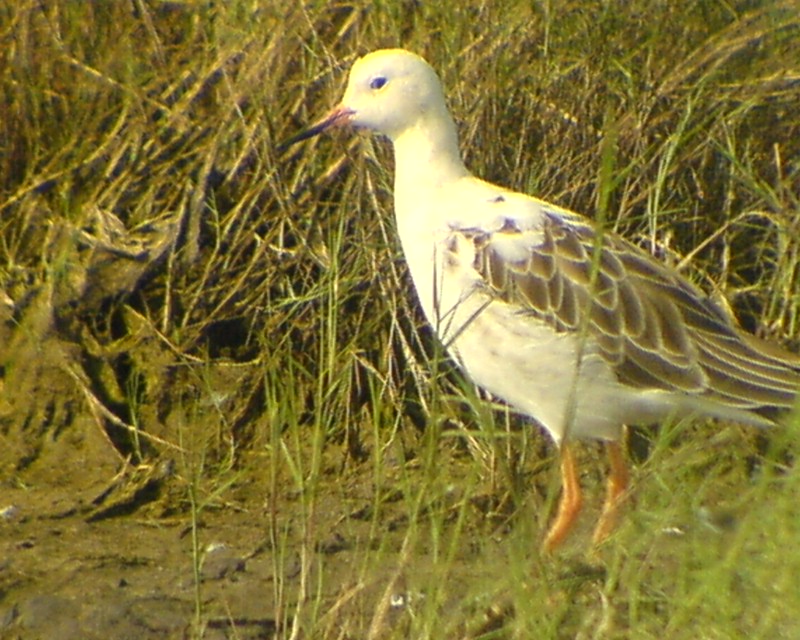 a very good close scope views) that were feeding along with Marsh & wood sandpipers, Black winged stilts, Black tailed Godwits, Little stints, Red & Green shanks, Ruffs (see photo-Right is non br. plumage & Left is partial br. plumage). Also saw Common coots with juveniles (with white under neck), Common teals, Shovellers, Gargeny teals, Grey Herons, Plenty of Glossy Ibises. A number of Marsh Harriers were seen flushing the birds. A sparrow hawk (with the gular stripe very clear) was seen loitering among trees.
A flock of about 25 ducks were looking place to land and circled for quite some time. In flight one of the duck showed clear white patches on wing. Since they were circling in a regular beat, I managed to catch them on the scope which confirmed the ducks to be Wigeons with the male, having that wing wing patch….They however didn’t settle and moved far away.
Amit was driving his santro, when we saw a huge flock of Grey herons, Great and Intermediate egrets, Spoonbills and White Ibises far away where we had seen the first Flamingos and Painted storks in the previous visits, when Amit pointed out that there was a very large white bird amongst the Egrets, after a careful scan thro’ our binocs the large bird turned out to be a pelican. I literally jumped out from the car, grabbed the scope and pointed towards the bird… and there it was …A great white or Rosy pelican feeding amongst the Egrets and spoonbills…Probably a first record for Mumbai region ?(comments from experts please). Suddenly all the birds flew towards us…..with the R.Pelican looking like a giant. It flew far away and then came back again and started soaring high up. A flock of about 200-250 greater flamingos also passed us….But we were so engrossed with this Pelican that the Flamingos got a second preference from us.
Some juvenile Brahminy kites and a short toed Snake Eagle gave company to the Pelican on the top.
Excited…. we moved towards the JNPT training centre that is situated in a forested hill some 2 Kms away hoping to find more ducks in the marshes surrounding the hill. We were not disappointed as, from the view point (an excellent spot where one can observe birds from above) we could see hoards of ducks roosting/ feeding in the waters. Apart from the ducks already mentioned there were some Bronzewinged Jacanas, Little grebes, Coots, Spotbilled and Lesser whistling ducks. A steepe Eagle gave us close view and from this point we could also spot about c3 Curlews far away on the sea shore.
Some other birds that were spotted included Western reef egrets (dark phase), small green bee eaters, Spotted & laughing doves, Red & Spotted munias, Collard stone chat, Oriental skylark, Rufous tailed lark, Citrine wagtails, Blackbreasted & Baya weavers, Shikra, Pond & Purple herons (after a long time) Common blue & white throated kingfishers, whiskered & gullbiled terns, Black & Brownheaded Gulls, Black drongo, Little & Indian cormorants, Open billed storks ( No Painted storks this time), Little & cattle egrets, Kentish plovers, Purple moorhens, L.T.Shrikes, Indian & Magpie robins, Blyth’s reed & greenish warblers, Ashy & Plain prinias, House & Palm swifts, Barn, Wiretailed & Red rumped swallows………..
While returning back we again visited the Pelican spot. The fellow was seen preening along with some Grey herons. While the Rosy Pelicans are a common sight in Gujarat and in North, this bird seemed to be a straggler to our region (A friend of mine informed, that they have been sighted in eastern Maharashtra once by Mrs. Shailaja Grubb.….May be this fellow was lured by the birds here to visit the rich habitat of Uran?).
Today (23rd Oct’04) again I had an opportunity to bird in Uran with some top Naval officials.....Courtesy Mr.K.B.Singh. However the Pelican was not seen. I will put up a separate list of birds seen today.
The high tide seems to be the right time to visit Uran as the waders in particular move towards higher mudflats when they do not find place along the shores……..and with so many birds turning up here, I hope to see lot of people move from their High tide (High tension human environs) to Uran Mudflats (Low tension nature environs).
Meanwhile……
Happy Birding
Addi The Birde
Sunday, September 19, 2004
Uran - UUU……RANNN of Mumbai (19.9.04)
Hi Birds,
Yes the flamingos have arrived in Mumbai …. About 187 of these flame birds ( Greater flamingos) were spotted in Uran ( Behind the JNPT Township ). Over the few days, both the Greater and the lesser flamingos will pour in the region, particularly in Sewri.
In all 68 Species of birds were seen during the Bnhs Navi Mumbai birding trip that was organised on Sep 19, 2004. About 27 people participated included 4 very enthu. Childrens.
Even with the non availability of Bnhs bus, people were excited to go to Uran, thanks to those who got their cars.
Uran ….. surely has turned into miniature Rann of Kucth…with salt pans…Open Mud flats…Flamingos….waders…and other migratory birds.
Apart from the flamingos, the migratory birds have also started coming in, however some notable species were Collard Stone Chat, Marsh Harriers, Gargeny teals, various Gull and Tern species. After a long time the sky was filled with some raptors, though many are still expected. In all some 5 raptor species were spotted.
The black breasted & Baya weavers are still breeding and both species were seen very busy with nest construction ( The Bayas on the trees and the Blackbreasted weavers in the Typha reeds). It was surprising to see Spot billed ducks mating at this time of the season ( 1 spotbill female with chicks was also spotted amongst the reeds). The Long tailed Shikes that are local migrant to our region arrives Mumbai in late August / Early September and on Sunday they were seen almost everywhere.
A nest of a plain prinia (Probably with chicks) and a half built nest of Black headed munia were also found.
A complete list is as below:
1. Lesser Whistling-Duck ( 1 Juvenile)
2. Black-headed Munia ( A pair constructing a nest)
3. Spot-billed Duck ( A pair Mating on water & also a Female with chicks)
4. Garganey ( Very far, but identified in flight-bluish grey flight feathers)
5. House Sparrow
6. Common Kingfisher
7. White-throated Kingfisher
8. Asian Koel
9. Red Avadavat ( Br+)
10. Rufous-tailed Lark
11. Rose-ringed Parakeet
12. House Swift ( Plenty at certain regular spots)
13. Asian Palm-Swift
14. Rock Pigeon
15. Laughing Dove
16. Spotted Dove
17. White-breasted Waterhen (One seen)
18. Common Coot ( Last Tuesday, also saw with chicks)
19. Purple Swamphen
20. Black-tailed Godwit (The commonest wader)
21. Common Greenshank
22. Common Sandpiper
23. Oriental Skylark ( Calls – Br+ Display)
24. Marsh Sandpiper (Plenty)
25. Little Stint
26. Ruff ( Some with partial Br+Plumage)
27. Common Redshank
28. Black-winged Stilt ( Neumerous)
29. Red-wattled Lapwing
30. Heuglin’s Gull ( Very far, probably with other large gull species)
31. Whiskered Tern
32. Little Tern
33. Gull-billed Tern
34. Short-toed Snake-Eagle ( ???—Very far)
35. Western Marsh Harrier ( Have arrived in good numbers)
36. Black-winged Kite ( 1 seen)
37. Brahminy Kite ( 1 seen)
38. Black Kite
39. Little Grebe ( 1 Juvenile)
41. Little Cormorant
42. Cattle Egret
43. Great Egret
44. Little Egret
45. Western Reef-Egret ( 1-Dark Phase)
46. Grey Heron
47. Indian Pond-Heron
48. Greater Flamingo ( 187- some immature)
49. Glossy Ibis ( Common)
50. Long-tailed Shrike ( Plenty)
51. Large-billed Crow / Jungle Crow
52. House Crow
53. Black Drongo ( 1 seen)
54. Oriental Magpie-Robin
55. Common stonechat ( 3 Females seen)
56. Asian Pied Starling
57. Jungle Myna ( Now seen regularly)
58. Common Myna
59. Red-rumped Swallow
60. Wire-tailed Swallow
61. Red-vented Bulbul
62. Red-whiskered Bulbul
63. Plain Prinia ( also one nest)
64. Ashy Prinia
65. Common Tailorbird
66. Black-breasted Weaver ( Br+)
67. Baya Weaver ( Br+)
68. White-throated Silverbill ( pair seen)
The notable absentees amonst the birds were Wagtails, Other species of Sandpipers, Plovers, Bee-Eaters, Other Raptors, Storks, Purple Herons, Jacanas & other Duck species.
However the highlight of the day was undoubtly the Greater flamingos that made the day. Even the childrens were very excited…..and in the coming days Uran surely will offer great treat and satisfaction to any birder.
The Birding Festival has started……….
Happy Birding,
Addi The Birde
* Thanks to the Core committee of BNHS Navi Mumbai Chapter for organizing such a wonderful trip, particularly Sagar Mhatre, Jacob & Vijaya Madam.
Yes the flamingos have arrived in Mumbai …. About 187 of these flame birds ( Greater flamingos) were spotted in Uran ( Behind the JNPT Township ). Over the few days, both the Greater and the lesser flamingos will pour in the region, particularly in Sewri.
In all 68 Species of birds were seen during the Bnhs Navi Mumbai birding trip that was organised on Sep 19, 2004. About 27 people participated included 4 very enthu. Childrens.
Even with the non availability of Bnhs bus, people were excited to go to Uran, thanks to those who got their cars.
Uran ….. surely has turned into miniature Rann of Kucth…with salt pans…Open Mud flats…Flamingos….waders…and other migratory birds.
Apart from the flamingos, the migratory birds have also started coming in, however some notable species were Collard Stone Chat, Marsh Harriers, Gargeny teals, various Gull and Tern species. After a long time the sky was filled with some raptors, though many are still expected. In all some 5 raptor species were spotted.
The black breasted & Baya weavers are still breeding and both species were seen very busy with nest construction ( The Bayas on the trees and the Blackbreasted weavers in the Typha reeds). It was surprising to see Spot billed ducks mating at this time of the season ( 1 spotbill female with chicks was also spotted amongst the reeds). The Long tailed Shikes that are local migrant to our region arrives Mumbai in late August / Early September and on Sunday they were seen almost everywhere.
A nest of a plain prinia (Probably with chicks) and a half built nest of Black headed munia were also found.
A complete list is as below:
1. Lesser Whistling-Duck ( 1 Juvenile)
2. Black-headed Munia ( A pair constructing a nest)
3. Spot-billed Duck ( A pair Mating on water & also a Female with chicks)
4. Garganey ( Very far, but identified in flight-bluish grey flight feathers)
5. House Sparrow
6. Common Kingfisher
7. White-throated Kingfisher
8. Asian Koel
9. Red Avadavat ( Br+)
10. Rufous-tailed Lark
11. Rose-ringed Parakeet
12. House Swift ( Plenty at certain regular spots)
13. Asian Palm-Swift
14. Rock Pigeon
15. Laughing Dove
16. Spotted Dove
17. White-breasted Waterhen (One seen)
18. Common Coot ( Last Tuesday, also saw with chicks)
19. Purple Swamphen
20. Black-tailed Godwit (The commonest wader)
21. Common Greenshank
22. Common Sandpiper
23. Oriental Skylark ( Calls – Br+ Display)
24. Marsh Sandpiper (Plenty)
25. Little Stint
26. Ruff ( Some with partial Br+Plumage)
27. Common Redshank
28. Black-winged Stilt ( Neumerous)
29. Red-wattled Lapwing
30. Heuglin’s Gull ( Very far, probably with other large gull species)
31. Whiskered Tern
32. Little Tern
33. Gull-billed Tern
34. Short-toed Snake-Eagle ( ???—Very far)
35. Western Marsh Harrier ( Have arrived in good numbers)
36. Black-winged Kite ( 1 seen)
37. Brahminy Kite ( 1 seen)
38. Black Kite
39. Little Grebe ( 1 Juvenile)
41. Little Cormorant
42. Cattle Egret
43. Great Egret
44. Little Egret
45. Western Reef-Egret ( 1-Dark Phase)
46. Grey Heron
47. Indian Pond-Heron
48. Greater Flamingo ( 187- some immature)
49. Glossy Ibis ( Common)
50. Long-tailed Shrike ( Plenty)
51. Large-billed Crow / Jungle Crow
52. House Crow
53. Black Drongo ( 1 seen)
54. Oriental Magpie-Robin
55. Common stonechat ( 3 Females seen)
56. Asian Pied Starling
57. Jungle Myna ( Now seen regularly)
58. Common Myna
59. Red-rumped Swallow
60. Wire-tailed Swallow
61. Red-vented Bulbul
62. Red-whiskered Bulbul
63. Plain Prinia ( also one nest)
64. Ashy Prinia
65. Common Tailorbird
66. Black-breasted Weaver ( Br+)
67. Baya Weaver ( Br+)
68. White-throated Silverbill ( pair seen)
The notable absentees amonst the birds were Wagtails, Other species of Sandpipers, Plovers, Bee-Eaters, Other Raptors, Storks, Purple Herons, Jacanas & other Duck species.
However the highlight of the day was undoubtly the Greater flamingos that made the day. Even the childrens were very excited…..and in the coming days Uran surely will offer great treat and satisfaction to any birder.
The Birding Festival has started……….
Happy Birding,
Addi The Birde
* Thanks to the Core committee of BNHS Navi Mumbai Chapter for organizing such a wonderful trip, particularly Sagar Mhatre, Jacob & Vijaya Madam.
Subscribe to:
Posts (Atom)